
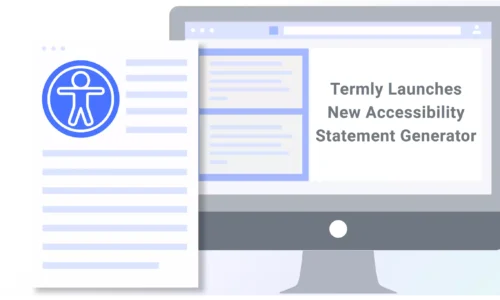
Termly is excited to announce the release of our new Accessibility Statement Generator, a legally backed automatic tool designed by our team to help businesses clearly communicate your commitment to digital accessibility and align with compliance standards.
Officially released in January 2026, this new generator expands Termly’s suite of compliance solutions to meet the needs of our customers.
Our Accessibility Statement Generator helps businesses easily explain the steps you’ve taken to make your website accessible, the standards you follow, and the improvements you plan to implement overtime.
Below, you can learn more about this exciting new resource.
- How Does Termly’s Accessibility Statement Generator Work?
- What Are the Key Features of Termly’s Accessibility Statement Generator?
- Which Businesses Need an Accessibility Statement?
- Why Website Accessibility Compliance Is a Growing Priority for Businesses
- How Termly Helps Businesses Manage Accessibility and Compliance at Scale
How Does Termly’s Accessibility Statement Generator Work?
Termly’s Accessibility Statement Generator is very easy to use and guides users through a straightforward step-by-step process to automatically make a custom statement in minutes.
The generator walks you through short prompts and multiple-choice questions about your website’s accessibility efforts, standards followed, and contact information, then it uses your answers to generate your unique statement.
The content and outputs from our generator that will appear in your final draft were written by Termly’s legal team.
This means, unlike the inaccurate outputs from LLMs and most modern AI technologies, our generator does not hallucinate or change your inputs. Instead, you get reliable, well-structured, standard-aligned outputs that help reduce your legal risks.
This intuitive process is accessible even for non-legal professionals.
You can publish your statement immediately to your website and easily update or customize it as your accessibility practices evolve.
How To Get Started with Termly’s Accessibility Statement Generator
Getting started is simple, either sign up for Termly or log into your existing account.
Once logged in, navigate to the ‘Policies’ button on the lefthand side of the Termly Dashboard, then select ‘Accessibility Statement.’
Answer the series of guided questions accurately and honestly.
It then makes your statement for you, which you can choose to customize before adding it to your website footer, legal page, accessibility section, or any other necessary location.
What Are the Key Features of Termly’s Accessibility Statement Generator?
Termly’s Accessibility Statement Generator includes several kay features to help businesses communicate with their users clearly and effectively:
- Make a clear commitment-to-accessibility declaration that outlines your dedication to inclusivity for all of your users.
- Disclose accessibility standards you follow, like the Web Content Accessibility Guidelines (WCAG) or Americans with Disability Act guidelines.
- Optionally document known accessibility limitations, an important aspect of honesty and transparency within these statements.
- Optionally document future improvement plans in a realistic way, to keep users informed of what’s coming next and the efforts you’re putting in.
- Easily add company contact information, as guided by the questions.
- Easily customize the content as needed to reflect changes in your website’s accessibility efforts.
These are essential features that help ensure your generated accessibility statement is informative, honest, and in-line with accessibility best practices.
Which Businesses Need an Accessibility Statement?
Any business operating a website benefits form publishing an accessibility statement.
Accessibility statements are meant to help inform users about your site’s usability for people with disabilities. Having one is increasingly relevant for businesses subject to consumer protection and accessibility-related laws, including:
- Small businesses
- Growing startups
- Ecommerce stores
- SaaS companies
- Global enterprises
- Nonprofits
- Professional websites/online portfolios
Having this statement demonstrates your commitment to inclusivity and transparency.
Even those in the early stages of improving website accessibility can use a statement to honestly disclose your current status and future goals.
Why Website Accessibility Compliance Is a Growing Priority for Businesses
As businesses face increased expectations to provide inclusive digital and online experiences, accessibility has become a growing priority.
Modern consumers are familiar with how accessibility standards like WCAG inform websites about how they can better serve users with disabilities. Laws like the ADA also influence accessibility expectations.
It also plays a key role in improving the overall user experience and building user trust, which can help significantly boost your brand’s reputation.
For businesses, earning and maintaining this trust with consumers is imperative for success.
How Termly Helps Businesses Manage Accessibility and Compliance at Scale
The Accessibility Statement Generator is a part of Termly’s broader compliance platform, which helps over 2 million businesses worldwide manage regulatory and legal requirements.
Our growing suite of compliance generators, consent management tools, and compliance solutions continue to help businesses more easily address accessibility, privacy, and data protection needs from a centralized, convenient platform.
We provide automated, customizable, and legally vetted tools that work seamlessly with your business as you scale up your compliance efforts.

Written by Natasha Piirainen
Natasha Piirainen is a privacy writer with a Bachelor’s Degree in English and Philosophy from Wheaton College and over 10 years of professional experience in research-driven content development.
Read all posts by Natasha Piirainen