
Plugins for WordPress can help website owners collect, manage, and document user consent for cookies and tracking technologies.
These tools play a critical role in how websites present consent choices, block non-essential scripts, and respect user preferences across different regions.
With so many plugins available, it can be difficult to tell which ones provide meaningful consent management versus those that only display a notice or rely on implied consent.
In this article, we consent plugins for WordPress consent plugins based on their consent capabilities, regional coverage, and overall functionality.
The Top 5 Consent Plugins for WordPress
Below view a table quickly comparing the 5 of the top consent plugins for WordPress.
| Plugin | Top Features | Legal Coverage | Recommended For |
| Termly |
|
|
|
| CookieYes |
|
|
|
| Complianz |
|
|
|
| Cookie Notice & Compliance |
|
|
|
| Cookiebot |
|
|
|
Termly
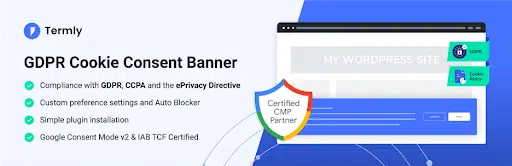
Termly offers one of the best consent plugins for WordPress, which combines consent collection, enforcement, and documentation with supporting tools in a single platform.
Rather than focusing on consent banners alone, Termly is designed to support the full consent lifecycle, from collecting and managing user consent to maintaining accurate, up-to-date consent disclosures as requirements evolve.
Key Consent Features
Termly includes a robust set of tools designed to help businesses manage user consent beyond basic notices:
- Customizable cookie consent banner with granular user controls
- Automated cookie scanning and categorization for consent purposes
- Consent preference storage and logging
- Automatic blocking of non-essential cookies before consent
- Google Consent Mode support
- Regional cookie banner display options
- Fully supports IAB TCF v2.2 Framework
These features work together to give site owners visibility into how cookies and trackers are used, giving users meaningful control over their preferences.
Legal Support
One of Termly’s strongest differentiators is that legal and privacy experts back its products.
Termly supports a wide range of global privacy laws, including major regulations across the EU, UK, United States, and other regions.
As requirements change, Termly regularly updates its tools to reflect new and revised laws, helping businesses keep their consent practices aligned with current expectations.
Termly’s legal-first approach helps businesses reduce the risk of relying on outdated templates or static consent tools.
Ease of Management
Termly is built to scale alongside a website’s privacy needs.
Policies, consent settings, and cookie information can be reviewed and updated from a centralized dashboard, making it easier to adapt as data collection practices change or new requirements apply.
This flexibility makes Termly well-suited for growing businesses, agencies, and websites operating across multiple regions.
CookieYes

This plugin centers on cookie consent management, combining a customizable consent banner with scanning and reporting features accessed through a connected dashboard.
Key Consent Features
- Customizable cookie consent banner
- Cookie scanning and categorization via a connected dashboard
- User-facing consent preference controls
- Consent logging and reporting
- Google Consent Mode v2 support
Legal Support
The tool is designed to support standard cookie consent requirements associated with major privacy regulations.
Its functionality emphasizes consent collection, cookie visibility, and reporting rather than broader privacy workflows such as policy lifecycle management or ongoing legal monitoring.
Best Use Case
Well-suited for small to mid-sized websites that need structured cookie consent, scanning, and reporting without a full privacy management platform.
Complianz

This plugin takes a rule-based, region-aware approach to consent management, allowing websites to configure cookie consent and cookie policy based on a visitor’s location.
Key Consent Features
- Cookie consent management with region-specific behavior
- Conditional script blocking based on consent status
- Guided setup using predefined rules
Legal Support
The tool supports multiple regional privacy frameworks such as the EU GDPR, CCPA, and LGPD by offering websites configurable cookie notices and cookie consent settings per region.
While this automation can help address location-based rules, it requires more initial configuration and periodic review as site setups evolve.
Best Use Case
A strong option for websites with international audiences that want to implement region-specific consent behavior through a structured configuration process.
Cookie Notice & Compliance

This plugin offers a flexible consent setup that can function as a lightweight cookie notice on its own or as part of a more structured consent workflow when connected to an external consent management platform.
Key Consent Features
- Customizable cookie notice banner
- Consent triggered via click, scroll, or close
- Configurable cookie expiration behavior
- Integration with an external consent management platform for expanded consent controls, including script blocking and consent records
Legal Support
On its own, the plugin focuses on presenting a consent notice and capturing basic signals.
When paired with its associated consent platform, it supports more explicit consent choices, region-aware configurations, and additional consent documentation aligned with modern consent expectations.
Best Use Case
Well-suited for content-focused websites and blogs that want an easy-to-deploy consent notice with the option to expand into more robust consent management without switching tools.
Cookiebot

This plugin allows websites to create a customizable cookie banner, configure consent settings based on website visitors’ geographical location, and record and manage cookie consent.
Key Consent Features
- Cookie scanning and categorization
- Multi-language support
- Consent management with script blocking
- Detailed cookie declarations
- Consent records and reporting tools
Legal Support
The tool supports a wide range of international privacy laws and helps document cookie usage and consent activity.
Its primary strength lies in visibility, record-keeping, and reporting.
Best Use Case
Commonly used by businesses with complex cookie setups or websites operating across multiple regions that require detailed cookie documentation over a lighter-weight setup.
What Makes a Consent Plugin for WordPress Effective?
A strong consent plugin for WordPress should do more than display a banner. At a minimum, it should support how consent is collected, enforced, and managed as expectations evolve.
An effective consent plugin should:
- Provide clear, user-controlled consent choices rather than implied acknowledgment,
- Allow users to review, update, or withdraw their consent preferences,
- Block non-essential cookies and scripts until valid consent is given,
- Help identify and categorize cookies so consent choices are informed and accurate,
- Support consent requirements across different regions and jurisdictions,
- Make it possible to review and adjust consent settings as a website’s data practices change,
- Honor updated user consent settings immediately, such as withdrawal of consent,
- Scale with a site over time, without requiring a complete replacement, as consent needs become more complex.
What Should I Watch Out For When Choosing a Consent Plugin for WordPress?
Not all consent plugins for WordPress offer the same level of functionality.
Some are designed to address a single, immediate need, while others are built to support consent management as websites grow and data practices expand.
Understanding these differences can help you avoid tools that may seem sufficient at first but become limiting later on.
Notice-Only Functionality
Some plugins focus primarily on displaying a notice without offering meaningful consent choices or enforcement.
While this may be acceptable for very simple sites, it can fall short as consent expectations increase or additional scripts are introduced.
Limited Visibility Into Cookies and Trackers
Without visibility into which cookies and trackers are active on a site, it becomes difficult to present accurate consent options or respect user preferences.
Tools that lack scanning or categorization features can leave gaps between what users are told and what actually runs on the site.
Static or Rigid Consent Setups
Consent expectations change over time, and one-size-fits-all configurations may no longer be appropriate.
Plugins that rely heavily on static settings or manual updates can require frequent adjustments as new tools, regions, or consent standards are introduced.
Lack of Ongoing Oversight
Because consent requirements are shaped by evolving legal and regulatory guidance, tools built without ongoing review or expert input may fall short of current expectations.
This can increase the risk of outdated consent behavior or incomplete user choice.
Poor Scalability Over Time
What works for a small blog may not work for a growing business.
As websites add integrations, expand into new regions, or collect additional data, consent needs become more complex.
Choosing a plugin that supports flexibility and growth helps ensure your consent setup can evolve alongside your website instead of becoming a constraint.
Keeping these tradeoffs in mind can make it easier to evaluate which consent plugin is the right fit.
Some websites may only need a straightforward way to present consent choices, while others require greater visibility, more vigorous enforcement, and more robust documentation as their data practices expand.
Understanding how each plugin handles consent and how easily it can adapt over time helps ensure your setup remains practical and effective as your website grows.

Written by Ali Talip Pınarbaşı, CIPP/E, & LLM
Ali is a London-based Data Privacy Law Solicitor with a Master of Laws Degree in EU Privacy law at King's College London. He has six years of experience in advising businesses on how to comply with data protection laws.
Read all posts by Ali Talip Pınarbaşı, CIPP/E, & LLM