


An affiliate disclosure is a statement informing website visitors that companies compensate you for mentioning their products in your content.
In the U.S., disclosures are required by the Federal Trade Commission (FTC) when endorsements or affiliate links are present, and they must be clear, noticeable, and easy to understand.
Read on to learn more about what an affiliate disclosure is, the legal requirements, and how to write one for your website.
How To Generate a Free Customized Disclaimer
You can generate a customized affiliate disclaimer in Termly by answering a few guided questions, then publishing your completed policy.
1. Go to Termly’s disclaimer generator.
2. Answer a few simple prompts and questions, and go through all the steps until you reach “Final Details.”
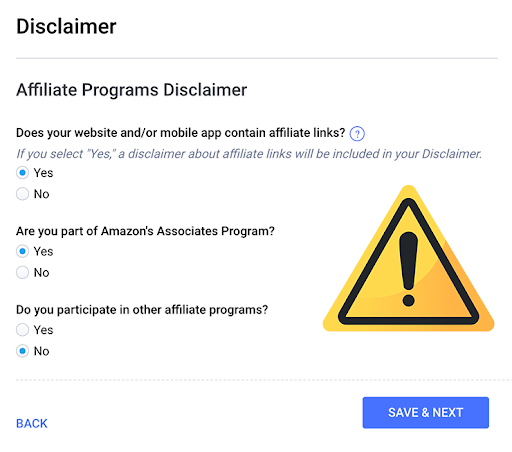
3. Once you’ve filled in everything and you are satisfied with the preview, click “Publish.”
You will then be prompted to create an account on Termly so you can save and further edit your legal disclaimer.
How Do You Write an Affiliate Disclosure?
You can write an affiliate disclosure by clearly stating your financial relationships, using simple language, and placing the disclosure where users can easily see it.
Follow these steps to create an effective affiliate disclosure.
1. Identify All Sponsored Content
First, identify all affiliate links or sponsored content on your website and explain that you get compensation from the companies whose products or services you link to.
Your disclosure should appear on every page of your website that features sponsored or affiliate materials.
2. Use Clear and Simple Language
Next, ensure you’re using plain language when letting users know that you receive compensation from companies for featuring or linking to their products in your content.
Avoid being overly lengthy or wordy, and don’t use any legalese or unnecessary jargon.
If you use terms that readers may not be familiar with, like affiliate marketing or affiliate links, explain them by including their definitions.
3. Make Your Disclosure Prominent
Your disclosure must be easy for users to find and read, so make sure you title it appropriately and display it prominently.
Format it in a way that users will easily notice, for example:
- Use large enough text size
- Ensure the font is easy to read
- Use a font color that stands out
4. Avoid Distracting Elements
Don’t use any distracting elements that reduce the noticeability or readability of your affiliate disclosure, such as:
- Graphics
- Buttons
- Links
In the U.S., this is required as part of the FTC requirements for affiliates and influencers.
5. Post Your Affiliate Disclosure In Multiple Places
To ensure that site visitors notice your disclosures, display them multiple times or in various locations.
For example, disclosures can be placed:
- In the website footer
- In the sidebar of your site
- Fixed in place so readers see it while scrolling
If your site often features affiliate links, post an affiliate disclaimer on every page.
Standard Affiliate Disclosure Example
Below is a simple affiliate disclosure example that follows FTC expectations and the best practices outlined above:
This example works because it reflects the core elements of an effective affiliate disclosure:
- Clearly states the relationship by explaining that compensation may be earned
- Uses simple, straightforward language that avoids confusion or legal jargon
- Sets expectations for users before they interact with affiliate links
- Maintains transparency by clarifying that there is no additional cost
In practice, your disclosure may vary depending on your content and partnerships. For example, some websites:
- Reference specific affiliate programs they participate in
- Add context about how commissions support their content
- Adjust tone to match their brand voice better
Regardless of how you customize it, your disclosure should follow the same structure outlined earlier: clearly explain the relationship, keep the language easy to understand, and place it where users will see it before engaging with affiliate links.
Real-World Examples of Affiliate Disclosures
Let’s review some affiliate disclosure examples to see how they’re incorporated into websites.
1. Statrys
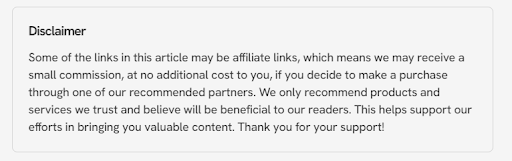
Statry’s finance blog contains information about its affiliate programs and affiliate links.
The disclosure informs readers that Statrys may receive a small commission at no additional cost to readers. They further explained that the affiliate partners and links are from products and services they trust, and their purpose is to help support more valuable content creation, as shown in the screenshot below.
Statrys only adds a disclaimer at the bottom of articles that contain affiliate links. https://cookieandkate.com/affiliate-discretion/
2. Cookie and Kate
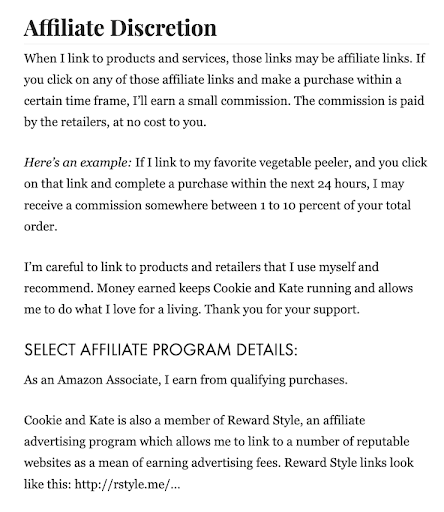
Cooking blog Cookie and Kate’s affiliate discretion page features information about their affiliate links and sponsored relationships, and
It clearly explains how commissions are earned through affiliate links and lists the affiliate programs the site owner participates in, as shown in the screenshot below.
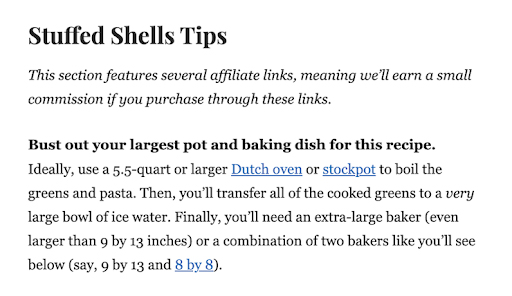
Additionally, an affiliate disclosure statement appears before the affiliate links in the site’s content and in the website footer, as shown in the following screenshot.
Follow Cookie and Kate’s example and link to an affiliate disclosure page to provide a more detailed description of your affiliate relationships and page-by-page affiliate disclosures.
Keep your language simple, and provide a clear explanation of how you’re compensated through the links.
3. The Beauty Look Book
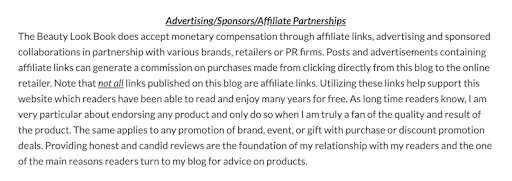
Cosmetics review blog The Beauty Look Book’s disclosure page includes an affiliate disclosure section describing the sponsored partnerships and affiliate arrangements the site owner is involved in.
It also covers the purpose of affiliate links and explains how the honesty and quality of the content are maintained, as shown in the screenshot below.
Be just as transparent about your business partnerships with other companies and explain the purpose of affiliate links so readers know you value honesty and want them to make informed judgments about your content.
The blog also features a fixed affiliate disclosure in the sidebar that appears on every post, as shown below.
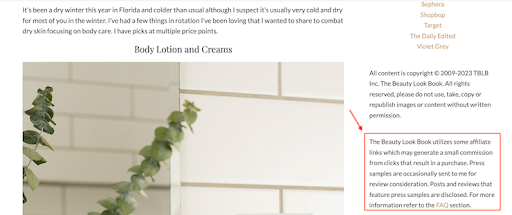
Adding a fixed affiliate disclosure in the sidebar is an excellent way to ensure noticeability and improve compliance with FTC requirements.
4. Where in the World is Nina
Travel blog Where in the World is Nina includes an Amazon affiliate disclosure statement at the top and bottom of every post.
The disclosure statement links to Where in the World is Nina’s privacy policy, where the Amazon affiliates’ disclosure reappears.
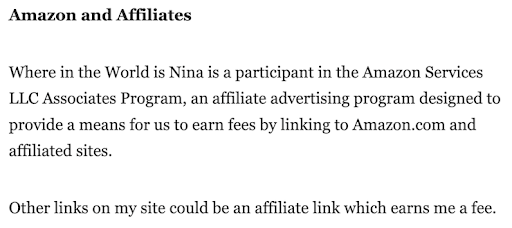
If you participate in the Amazon Associates Program, you must include an affiliate disclosure that identifies you as an Associate, as this example does.
You can create a customized disclaimer with an affiliate section using our free disclaimer generator.
Affiliate Disclosure FAQ
What Is an Affiliate Disclosure?
An affiliate disclosure or disclaimer is a statement on your website informing users that you are compensated by companies for promoting, reviewing, or recommending their products or services.
It alerts users to the presence of affiliate links on your site, which are URLs that link to another business’s products or services.
Site owners typically earn commissions when users make purchases through these links.
Affiliate link disclosures are required by groups such as the FTC in the U.S., but it’s also a business best practice to include them.
Product reviews or recommendations can influence users’ purchasing decisions. An affiliate disclosure establishes transparency and trust with your users, allowing them to make more informed decisions.
What Are the Affiliate Disclosure Requirements?
In the U.S., you must have an affiliate disclosure if you’re financially or otherwise compensated by companies to review their products on your site as part of the FTC endorsement guide.
An FTC-compliant disclosure should “clearly and conspicuously” describe the nature of your relationship with the company you’re posting about, including that they compensate you.
You must write your affiliate blog disclaimer in user-friendly language so all readers can easily understand it.
In addition to the FTC, affiliate programs you participate in may require you to have an affiliate disclosure.
For example, the Amazon Associates Program’s Operating Agreement requires Amazon Associates to include an Amazon affiliate disclosure on their site, as shown in the screenshot.

To operate your business website ethically and avoid legal action, you must comply with FTC guidelines and any applicable affiliate program rules.
Where Should You Put an Affiliate Disclosure?
You should place an affiliate disclosure as close as possible to affiliate links or endorsements, so users see it before engaging with the content.
Disclosures should appear on every page that includes affiliate links and may also be included in your website’s footer, sidebar, or a dedicated disclosure page. Many websites use a combination of a full-disclosure page and shorter notices embedded directly in the content.
Where Should I Place Affiliate Disclosures on My Website?
You should place affiliate disclosures as close as possible to affiliate links or endorsements, so users see them before engaging with the content.
Place a disclosure on every page that includes a sponsorship, affiliate link, or endorsement.
Your affiliate link disclosure should always come before any affiliate links, so users know about your affiliate partnerships before clicking on one.
Some examples of places where you should link your affiliate disclosure page include:
- Site header
- Footer
- Sidebar
- Terms and Conditions Agreement
- Privacy policy
Make An Affiliate Disclosure Page
You may choose to create a dedicated affiliate disclosure page to provide more detailed information about your partnerships and compensation.
Just remember to also disclose your relationship with affiliates on your disclaimer page.
Include a hyperlink to your affiliate disclosure page throughout your site, and include smaller affiliate disclosures close to any affiliate links that appear in your content.

Natasha Piirainen is a privacy writer with a Bachelor’s Degree in English and Philosophy from Wheaton College and over 10 years of professional experience in research-driven content development.
Read all posts by Natasha Piirainen
Reviewed by Masha Komnenic CIPP/E, CIPM, CIPT, FIP
Masha Komnenic is a legal counsel and Termly’s Director of Global Privacy, who received her law degree from Belgrade University. She specializes in implementing, monitoring, and auditing business compliance with privacy regulations (HIPAA, PIPEDA, ePrivacy Directive, GDPR, CCPA, POPIA, LGPD).
Read all posts reviewed by Masha Komnenic CIPP/E, CIPM, CIPT, FIP
Generate a FREE Disclaimer