

The way you collect email addresses on your website is subject to a growing web of privacy regulations. If you’re not compliant, you’ll lose trust among subscribers and could even be subject to hefty fines.
Here are 8 simple steps you can take to stay compliant when collecting emails on your website and improve the impact of your email marketing.
Key Takeaways
- Staying compliant when collecting emails is essential, but easier than you think.
- You must collect consent, be transparent, and give people control.
- Email marketing tools provide features that help, so choose wisely.
What is Email Marketing Compliance?
Email marketing compliance refers to legal standards that govern how businesses collect email addresses, communicate with subscribers, and manage personal data.
Compliance covers three main areas:
- Consent: Did the person actually agree to receive emails from you?
- Transparency: Do they know what data you’re collecting and why?
- Control: Can they easily access, update, or delete their data?
Once you understand these 3 areas, you’ll be sending compliant emails in no time.
Why Should You Prioritize Compliance?
You should prioritize compliance in email marketing to avoid fines for noncompliance and to improve your marketing efforts.
Failing to meet compliance standards can result in substantial fines and damage your reputation, leading to a loss of subscriber trust.
Non-compliant sending practices are also more likely to result in spam complaints and low engagement, affecting deliverability across your entire list, meaning people are less likely to see your emails.
Think of it like this: Sending emails and messages to who people actually want to receive it means you’re more likely to increase opens, clicks, and sales.
What Key Privacy Regulations Should You Keep in Mind?
There are various regulations at the regional and national levels that you should be aware of.
These can apply to you if you have subscribers in the relevant area, even if your business isn’t based there.
General Data Protection Regulation (GDPR)
The GDPR applies to any business that collects or processes the personal data of EU residents, regardless of where the business is based.
Under the GDPR, personal data includes email addresses, names, IP addresses, location data, and even behavioral data such as click history.
Virtually every aspect of email marketing falls within the scope of the GDPR.
Key GDPR requirements for email marketers include:
- Obtaining explicit, active consent before sending marketing emails
- Providing a clear explanation of how subscriber data will be used
- Giving subscribers the right to access their data on request
- Honoring the right to erasure (also called the “right to be forgotten”) requests by permanently deleting all data
- Notifying affected individuals of a data breach within 72 hours
- Allowing subscribers to request a copy of their data in a portable format
Penalties for non-compliance under the regulation can reach as high as €20 million or 4% of your annual global turnover.
CAN-SPAM Act (United States)
The CAN-SPAM Act is the United States’ primary law governing commercial email.
Unlike the GDPR, CAN-SPAM takes an opt-out approach, meaning you can generally send email marketing campaigns without prior consent, as long as you meet certain requirements.
Those requirements include:
- Using accurate sender information
- Don’t use deceptive subject lines
- Clearly identifying relevant messages as advertisements
- Including a valid physical postal address in every email
- Providing a clear and easy way to opt out of future emails
- Honoring opt-out requests within 10 business days
Failure to adhere to CAN-SPAM can result in fines of up to $53,088 per email.
While CAN-SPAM regulates the entire U.S., state laws, such as California’s CCPA, Virginia’s VCDPA, and others, create additional obligations for businesses operating in or targeting residents of those states.
CASL (Canada’s Anti-Spam Legislation)
Canada’s Anti-Spam Legislation (CASL) requires express or implied consent before sending any commercial electronic message to Canadian recipients.
- Express consent means the recipient has clearly and explicitly agreed to receive messages from you.
- Implied consent may exist if there’s an existing business relationship, but it expires after a set period (typically two years).
CASL also requires:
- Clear identification of the sender
- A working opt-out mechanism in every message
- Opt-out requests to be honored within 10 business days
Penalties under CASL can reach up to CAD $10 million per violation for businesses.
Other Global Regulations
Many other regions have anti-SPAM or data privacy frameworks in place, for example:
- Australia’s Spam Act 2003: Requires consent and a functional unsubscribe mechanism for all commercial messages
- Brazil’s LGPD (Lei Geral de Proteção de Dados): Brazil’s data protection law closely mirrors GDPR in many respects
- India’s DPDP Act (Digital Personal Data Protection Act, 2023): India’s new framework introduces consent requirements and data principal rights
8 Steps to Stay Compliant When Collecting Emails
By following these 8 steps, you can collect email addresses and send messages in a way that adheres to applicable legal standards.
I’ll also show you how your email marketing service provider can help, using MailerLite as an example, thanks to its strong GDPR compliance features.
Legal disclaimer: Whether you are compliant with privacy regulations ultimately comes down to how you process data and send emails, as well as the specific regulations you are subject to. While these best practices can point you in the right direction, you should consult with a legal professional for true peace of mind.
1. Obtain Clear and Explicit Consent
Consent is the foundation of compliant email marketing.
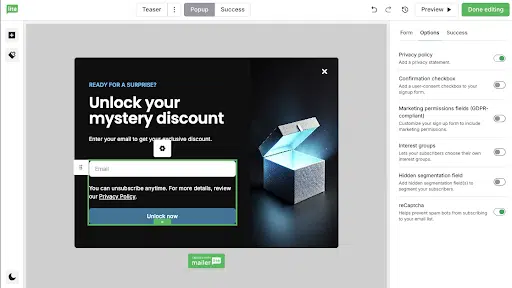
Create GDPR compliant email sign-up forms that have consent mechanisms that ensure your obtaining consent from users that is informed, specific, and freely given.
Ensuring that it is clear what someone is signing up for when they enter their email address. If you want to send someone a newsletter and also partner deals, make sure it’s obvious.
For example, the MailerLite form shown in the screenshot below clearly highlights that the user will receive a newsletter and the Ultimate Guide series when they sign up.

You can collect consent by ensuring that what the user is signing up for is clear from the form copy, like in the above example.
If you are building those sign-up forms yourself, an online form builder lets you put the consent checkbox and the privacy policy link into the form itself, so the opt-in is captured at the point of collection.
Opt-in checkboxes can help you collect explicit, active consent. But be sure to avoid pre-ticked checkboxes, as these are explicitly prohibited under GDPR.
2. Provide Transparency with a Privacy Policy
GDPR’s right of access means subscribers can ask you at any time to explain exactly how you’re using their data.
The easiest way to handle this is to tell them upfront via your privacy policy and then link to this from your opt-in form.
With MailerLite, it’s easy to add your privacy policy in a link to any form.
If you don’t have this policy, use Termly to generate one based on your business.
3. Keep Track of Opt-Ins
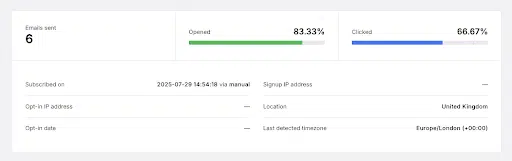
It’s useful to keep a record that shows when and how people opted in to your list.
For example, see how MailerLite keeps track of essential details such as the IP address, location, date, time, and source of the opt-in in the screenshot below.
You can also enable double opt-in, a system that requires the user to click on a link in an email to join your list.
This ensures it really was the owner of the email address who opted in, while also further solidifying the compliance paper trail.
These features may help, but they don’t guarantee compliance. This ultimately comes down to how you use the data of the people who opt in.
4. Let People Delete Their Data
A key compliance requirement is that you have a process to let people delete the data you store about them.
Simply unsubscribing your subscribers isn’t enough. Even though it stops the user from receiving your emails, their information is still kept in your system.
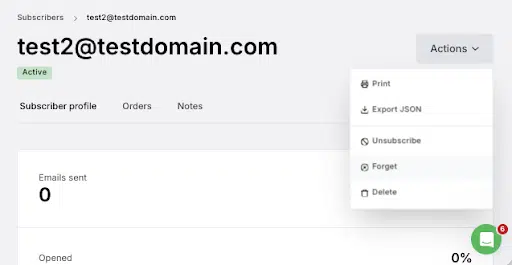
MailerLite’s Forget feature deletes all the user’s data, from their email address to their profile, clicks, and reports, making it easy to fulfill deletion requests.
See an example in the screenshot below.
5. Let People Access Their Data
You must also allow people to access the data you have stored about them.
For example, MailerLite’s data export feature allows you to download a subscriber’s data in PDF or JSON format when they make a right of portability request.
You can simply export the data from within the subscriber’s profile and send them the report.
6. Filter Subscribers by Location
Another way to stay compliant is to vary the email content you send based on user location.
For example, MailerLite’s subscriber filter includes a Location rule, which allows you to identify and segment subscribers depending on their country.
See more in the screenshot below.
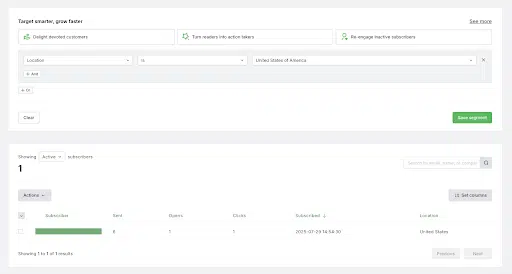
Use this feature to apply different consent standards to specific geographic groups.
7. Use Trusted Service Providers and Software
Under regulations like the GDPR, you’re not just responsible for your own practices; you’re responsible for the practices of every third party that processes your subscribers’ data, including your email marketing platform.
When choosing a tool, check for features like:
- ISO 27001 certification: This verifies that the tool has a comprehensive system to manage and protect sensitive data
- A formal Data Processing Addendum (DPA): This is a contract required under GDPR that governs the relationship between the brand and the ESP
- Sub-processor transparency: MailerLite’s DPA also covers its use of sub-processors (other vendors they work with), giving you full visibility into the data processing chain.
These standards aren’t just relevant to your email service provider.
Look for the above features in your CRM, analytics tools, e-commerce platform, or any other tool that stores customer data.
8. Provide a Clear Opt-Out Option
Every marketing email you send must include a clear, easy-to-find unsubscribe option.
The ability to opt out of communication is required by CAN-SPAM, CASL, GDPR, and virtually every other email regulation globally.
For example, MailerLite automatically includes an unsubscribe link in every email sent through the platform.
This protects both you and your subscribers.
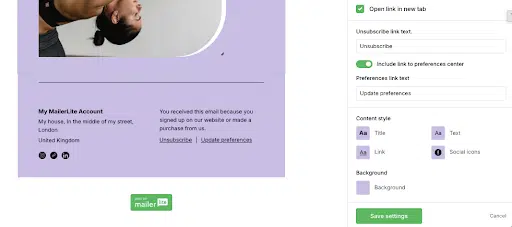
Beyond the basic unsubscribe, MailerLite also offers a Subscriber Preference Center, where subscribers can manage their own preferences rather than simply opting out entirely.
This is a powerful tool for reducing unsubscribes.
Subscribers can choose to receive fewer emails, opt out of specific types of content, or update their details instead of opting out of everything.
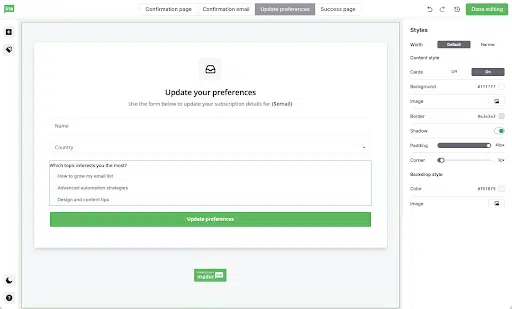
More control means your subscribers stay on your list on their own terms, and you keep a subscriber you might otherwise have lost.
What Happens If You Don’t Comply?
Failing to comply with privacy regulations and anti-SPAM laws can result in both legal and reputational consequences.
Potential Fines and Penalties
The financial consequences of non-compliance can be significant:
- GDPR: Fines up to €20 million or 4% of global annual turnover (whichever is greater)
- CCPA/CPRA: Up to $7,988 per intentional violation
- CAN-SPAM: Up to $53,088 per email in violation
- CASL: Up to CAD $10 million per violation for businesses, and CAD $1 million for individuals
Regulators across the EU have issued major fines against companies of all sizes, from SMEs to multinational corporations.
Reasons include failures in consent management, data handling, and breach notification.
Reputational Damage and Loss of Trust
You may be able to recover from a fine. But brand reputation damage is harder to undo.
When a business is found to have mishandled subscriber data, the news travels fast. Public trust can take years to rebuild.
This is especially important for businesses in industries where data sensitivity is high or where the customer relationship depends heavily on trust.
Legal Action and Litigation
Beyond regulatory fines, businesses under laws like the CCPA/CPRA can face civil litigation from individuals whose rights were violated.
In these jurisdictions, data protection law allows individuals to seek compensation for material and non-material damages resulting from unlawful data processing.
The cost of litigation, even if you are successful, can be substantial.
Compliance Is Straightforward with the Right Steps
This article may sound alarming, but staying compliant just means following the best practices listed and choosing a trustworthy email marketing service provider that handles much of the heavy lifting for you.
Start with these four fundamentals:
- Get explicit consent,
- Be transparent about how you use data,
- Make it easy to opt out, and
- Work only with service providers who take compliance as seriously as you do.
Do that consistently, and you’ll both stay compliant and build an email list that’s more engaged, loyal, and valuable over time.

Written by Duncan Elder
I’m Duncan, a content writer at MailerLite. I love building websites with no-code tools and writing about what I learn. I created my first site in 2011 with Blogger—it’s safe to say that website builders have improved a lot since then!
Read all posts by Duncan Elder
Reviewed by Masha Komnenic CIPP/E, CIPM, CIPT, FIP
Masha Komnenic is a legal counsel and Termly’s Director of Global Privacy, who received her law degree from Belgrade University. She specializes in implementing, monitoring, and auditing business compliance with privacy regulations (HIPAA, PIPEDA, ePrivacy Directive, GDPR, CCPA, POPIA, LGPD).
Read all posts reviewed by Masha Komnenic CIPP/E, CIPM, CIPT, FIP