


A Cookie Consent Manager is a tool that helps manage your entire cookie consent process, from obtaining user consent to keeping consent logs and fielding requests from users to follow through on their rights.
It’s a solution that takes care of the technical aspect of consent management as outlined by data privacy laws, like the GDPR, the CCPA, the ePrivacy Directive, and others that exist around the world.
This is part of Termly’s ‘Ask the Privacy Experts’ series, where a member of our team briefly answers one of the top questions we hear from businesses about how data privacy and consent management impacts them.
What does a Cookie Consent Manager actually do?
A Cookie Consent Manager is a tool that websites can use to obtain and honor user consent choices regarding the use of cookies, pixels, and other trackers.
This helps keep your website aligned with the obligations outlined by data privacy laws like the GDPR, the CCPA, and the ePrivacy Directive, which heavily impact the use of cookies.
Cookie Consent Managers usually include the following features, which you can customize based on your unique needs:
- Website scanner to check for cookies: You can typically run your website through a website scanner that will find, categorize, and define all cookies and trackers your website is using and organize them in a scan report.
- Cookie Policy Generator: A good cookie consent manager will feature a cookie policy generator, which is automatically updated whenever you re-scan your site.
- Cookie consent banner: A cookie consent manager also includes a cookie banner, with features like regional consent settings and script auto-blocking.
- Consent preference center: These tools enable you to easily provide your website users with a consent preference center, so they can easily change their minds at any time, which is required by laws like the GDPR and the CCPA.
- User consent logs: Your cookie consent manager should maintain secure consent logs from visitors to help in case a privacy audit or investigation occurs.
- DSAR supports: A proper cookie consent manager provides you with an embeddable Data Subject Access Request form or other types of support to make receiving and responding to customer requests to follow through on their rights more efficient.
Depending on which laws apply to your website, you might need additional cookie consent management features, for example:
- Script autoblocking: If you need to follow laws like the GDPR or California’s wiretapping law the CIPA, you might need to use script autoblocking features, which prevents cookies from loading on your website users’ browsers unless the actively give their consent by interacting with your consent banner.
- Cross regional consent: If your business must comply with one or more data privacy law, cross regional consent settings enable you to present your users in specific areas with a compliant consent banner based on the different laws.
- Google Consent Mode Support: Google Consent Mode helps websites obtain marketing data from website visitors in a way that aligns with privacy laws, and certain cookie consent managers can help you access these functions.
- IAB TCF support: Websites can align with the IAB TCF to ensure you’re collecting European users’ consent for advertising and sharing that data in line with privacy laws.
- Multi-language settings: If you have users from around the world, cookie consent managers with multi-language support help your users see your cookie banner and website policies in their preferred language.
Why do websites need a Cookie Consent Manager?
Websites need to use a cookie consent manager to align with data privacy laws and to build trust with modern website users.
The following data privacy laws might apply to your business or protect your website visitors, and it’s your responsibility to ensure your website has the proper technical measures in place to meet the obligations outlined by the laws:
- General Data Protection Regulation (GDPR)
- The ePrivacy Directive (EU Cookie Law)
- California Consumer Privacy Act (CCPA)
- Colorado Privacy Act (CPA)
- Brazil’s General Data Privacy Law (LGPD)
- Virginia Consumer Data Privacy Act (VCDPA)
- Other U.S. state-level privacy laws
In addition to legal compliance, modern consumers also care about their personal privacy online and want to know what cookies you’re placing on their browsers, why you’re using them, and what data you’re collecting about them.
Being upfront and honest with your website visitors about your use of cookies or other trackers shows you’re an honest, privacy-literate, and secure business, which helps build trust with your new and future consumers.
How do I know what kind of Cookie Consent Manager my website needs?
To determine which kind of Cookie Consent Manager your website should use, you first need to know which laws you must comply with.
Once you’ve determined which laws impact your business and website, you can find a Cookie Consent Manager that aligns with the requirements of those laws.
Look for tools that are built by lawyers and data privacy experts, and make sure whatever tool you use is regularly updated and audited.
For example, Termly’s Cookie Consent Manager is one of the best out there for businesses looking to streamline managing user consent.
It can help you align with opt in and opt out consent requirements from around the world and has top of the line features including script autoblocking, custom cookie banner designs, policy generation, and auto-updating policies.
Sign up today and see how Termly can help you manage cookie consent.

Natasha Piirainen is a privacy writer with a Bachelor’s Degree in English and Philosophy from Wheaton College and over 10 years of professional experience in research-driven content development.
Read all posts by Natasha Piirainen
Reviewed by Masha Komnenic CIPP/E, CIPM, CIPT, FIP
Masha Komnenic is a legal counsel and Termly’s Director of Global Privacy, who received her law degree from Belgrade University. She specializes in implementing, monitoring, and auditing business compliance with privacy regulations (HIPAA, PIPEDA, ePrivacy Directive, GDPR, CCPA, POPIA, LGPD).
Read all posts reviewed by Masha Komnenic CIPP/E, CIPM, CIPT, FIP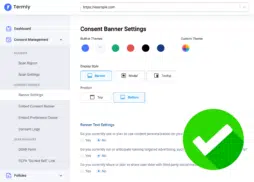
FREE Cookie Consent Manager for Websites