


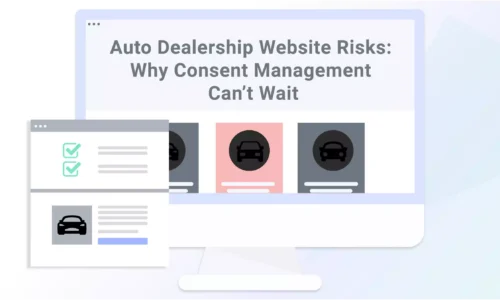
Auto dealership websites must comply with consent management requirements, which includes having a properly configured consent banner, cookie policy, and a preference center available for site visitors.
Learn all about consent management for auto dealerships in this bite-sized guide.
Key Takeaways
- Auto dealership websites need to follow consent management guidelines to lawfully place cookies or other trackers on users’ browsers, including those used for marketing purposes.
- Your auto dealership site needs a properly configured cookie banner, cookie policy, and a preference center available for users.
- Laws like the CCPA, GDPR, and FTC rules impact how auto dealerships manage user consent for cookies and other trackers online.
- Some of these laws, like the CCPA, require you to give users a way to opt out of direct marketing and targeted advertising.
Does My Auto Dealership Website Need to Manage User Consent?
Yes, if you’re using internet cookies or other tracking technologies, your auto dealership website most likely needs to manage user consent. This includes using cookies for purposes like targeted advertising and user analytics.
Learn all about why websites need to manage cookie consent in our video below.
How To Manage User Consent for Auto Dealerships
Your site can manage user consent by presenting users with three key solutions:
- A properly configured cookie consent banner,
- A link to an updated, accurate cookie policy,
- A link to a preference center so users can easily change their minds.
Why You Need a Properly Configured Consent Banner
Presenting your users with a properly configured consent banner helps auto dealership websites align with privacy law requirements, keeps your users properly informed, and gives them choice and control over their online privacy.
For example, the table below compares what compliant cookie consent banners look like under two common privacy laws, the GDPR and the CCPA.
GDPR Cookie Consent Banner Requirements |
CCPA Cookie Consent Banner Requirements |
Possible button configurations on the consent banner may include:
|
Possible button configurations on the consent banner may include:
|
| Follows an opt-in model. | Follows an opt-out model. |
| No cookies or trackers should be deployed unless active consent is granted by the user. They have the right to change their mind easily at any time. | Cookies can be placed on browsers, but your site must have a way for users to opt out of specific kinds, and you need to honor that choice once it’s made. |
Presenting users with a dynamic cookie consent banner with regional capabilities helps your auto dealership meet these guidelines.
These configurations also enable your users to read and understand how their data is being processed by your site, for what purposes, and provide them with options regarding if they want to allow it to occur or not.
Why You Need an Accurate, Updated Cookie Policy
Having a cookie policy helps your site meet transparency requirements outlined by privacy laws and is an easy way to ensure your users are genuinely informed about all categories of cookies and trackers your site uses.
Privacy laws require you to inform people about what data you want to track and why. This is a standard requirement.
Having a cookie policy is an efficient way to meet this guideline.
Presenting your users with this information in the form of a cookie policy also allows them to have full knowledge of what cookies you’re using and why.
Freely supplying them with this knowledge is important because you’re placing something on their browser or device, which means you’re likely collecting their personal information.
Being transparent about the cookies your site is using is actually a good thing!
Cookies are not inherently bad. They help websites function properly. They help improve the overall user experience. They help create a more personalized online environment.
Being honest about this ensures website users that you’re only collecting necessary information and not carelessly mining their data irresponsibly, building trust and helping create a safer, more sustainable internet.
Why You Need a Preference Center
Your auto dealership website needs a preference center available for users because it enables them to easily change their minds at any time, which is required by laws like the GDPR.
It also helps you meet requirements outlined by laws like the CCPA.
In this case, users have the right to opt out of data processing for purposes like targeted ads and the selling or sharing of their data. You must provide a means for them to follow through on this right, and having a preference center can help you align with this standard.
You can link it directly to your consent banner or place it in the footer of your website.
A preference center can also give your users more control over which categories of cookies they want to allow and which they want to decline.
This gives them granular choices over their information and enables your site to still place helpful cookies when given permission.
Frequently Asked Questions About Consent Management for Auto Dealerships
Below, you can read through answers to frequently asked questions we get about consent management for auto dealership websites.
Why does my auto dealership need to manager user consent?
Consent management is required by data privacy laws like the GDPR and the CCPA, and modern internet consumers expect transparency and choice regarding how their personal data is used online.
The proof is in the data. Tableau found that 48% of consumers have stopped shopping with a company because of privacy concerns.
Research from Cisco suggests around 81% of users believe the way a company treats their personal data is indicative of the way it views them as a customer.
Properly managing user consent helps your auto dealership stay in line with applicable laws and prevents losing customers due to gaps in your website’s privacy controls.
What cookies or trackers does my site use that require user consent?
The cookies you’re using that require user consent varies depending on which laws apply to you and your consumers.
If you’re subject to following the GDPR, for example, you must obtain consent from users for any unnecessary or non-essential cookies or trackers.
If you’re subject to following the CCPA, you need to provide opt-out options for users regarding any cookies user for targeted advertising, the collection of sensitive personal data, or profiling.
Run your website through our free site scanner to discover what cookies your website uses.
It will find, classify, and organize the cookies into a custom scan report, which can then get turned into a properly formatted cookie policy.
Cookies, pixels, tags, and other trackers are used for several purposes, including:
- Basic user information, i.e., language preferences, location, device details.
- Website activity and behavioral data, i.e., pages visits, time spent on each page, clicks.
- Session information, i.e., if a user is logged in, items in a shopping cart, Session IDs.
- Marketing & advertising data, i.e., ads users have seen, interests based on browsing behavior, if a user returns to a site.
- Analytics/performance, i.e., number of visitors, bounce rates, traffic sources.
- Personalization data, i.e., saved preferences, recently viewed products, customized content.
Auto dealerships tend to use cookies to track details about website visitors, including:
- Which vehicles visitors view,
- If they started filling out a financing form,
- If they clicked on a promotion or ad,
- If they return to the site at a later time
Are there any exceptions when it comes to obtaining cookie consent?
Yes. Some cookies are used to help websites function and don’t process personal data. These are known as strictly necessary or essential cookies.
Typically, consent is not required to use this type of cookie.
Does Termly Help Auto Dealerships Manage User Consent?
Yes, Termly is an ideal resource for auto dealerships that need to manage user consent on websites.
Our legally backed consent management platform was built by privacy experts and can help websites align with opt in and opt out consent requirements outlined by laws around the world, including the GDPR, the CCPA, other U.S. state level privacy laws, and more.
Termly can help you generate a cookie policy, configure a cookie banner with regional consent settings, set up a preference center for your users, and more.

Natasha Piirainen is a privacy writer with a Bachelor’s Degree in English and Philosophy from Wheaton College and over 10 years of professional experience in research-driven content development.
Read all posts by Natasha Piirainen
Reviewed by Amanda Lee, CIPP/US
Amanda is a Documentation Specialist and Certified Privacy Professional (US). She converts product documentation into easily understood product for Termly's customers. She also has strong understanding of US privacy laws and regulations, helping to keep customer policies up to date at a time when US states are enacting more and more privacy laws.
Read all posts reviewed by Amanda Lee, CIPP/US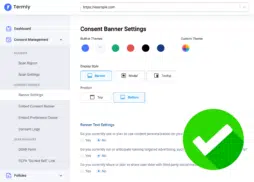
Generate a FREE Cookie Banner