

If you own an AI startup or company, you must ensure you’re obtaining adequate consent from website users for data collection and processing in a way that aligns with applicable data privacy laws.
Your website might use Internet cookies or other trackers to monitor the online behavior of your visitors. AI tools also typically rely on the use of a lot of information, some of which can fall under the legally protected category of ‘personal data’.
Below, learn how to manage cookie consent for AI startups and companies, including the laws that might impact you, different ways to configure your cookie banner, how to scan your site for cookies and use that information to make an accurate cookie policy, and more.
- What is Cookie Consent for AI Startups and Companies?
- Does my AI Startup Need to Prioritize Cookie Consent?
- How Do I Know if my AI Company's Website Uses Cookies?
- What Laws Impact Cookie Consent for AI Startups and Companies?
- How Do I Set Up Cookie Consent for My AI Company?
- How Does Termly Help AI Startups and Companies with Cookie Consent?
What is Cookie Consent for AI Startups and Companies?
Cookie consent is the same for AI startups and companies as it is for any other business.
It’s a way to obtain valid legal consent from consumers for certain types of data collection and processing. Typically, it involves the following components:
- A properly configured cookie banner with appropriate button choices that pops up and is presented to your website visitors when they first land on the webpage,
- A link to an accurate, up-to-date cookie policy clearly categorizing, listing and explaining all the cookies your website wants to place on their device, and why,
- A link to a Preference Center enabling website visitors to easily change their mind and give or withdraw consent at any time.
The technical aspects of your consent banner must function as intended, and in accordance with applicable privacy laws.
If a user opts out of cookies, then the banner should properly communicate that to your website, and no cookies should be placed on their browser.
Generally, no cookies should be dropped prior to the user indicating their preference, unless they are essential to the functioning of the website.
Does my AI Startup Need to Prioritize Cookie Consent?
Your AI startup or business should prioritize cookie consent for several reasons:
- You might be legally required to follow certain cookie consent rules if you fall under laws like the GDPR, the CCPA, or the ePrivacy Directive. I’ll talk more about this later.
- Third-party services you rely on might use cookies and deploy them on your internet visitors’ browsers, and you may be obliged to disclose this information to your users.
- Modern internet users care about their privacy and want to know what cookies you’re placing on their browsers, why they’re there, and what those cookies do.
- It keeps you informed about the cookies your site is using, which can help you more easily monitor the safety and security of your platform.
- AI platforms that don’t even have a cookie policy might be viewed by the general public as dishonest, sneaky, or too risky to use.
How Do I Know if my AI Company’s Website Uses Cookies?
You can tell if your website is using cookies by running the URL through a free tool like Termly’s cookie scanner.
This is an easy and free way to quickly categorize, define, and sort all the cookies that your site is using. You can then use the cookie report to make an accurate and up-to-date cookie policy.
Because of its convenience, it’s the simplest method for discovering what cookies your AI startup website is using.
However, you can also manually check what cookies your site is using by using the browser developer tools.
Here are some quick directions:
- Step 1: Right click on the page.
- Step 2: Click ‘Inspect’
- Step 3: Click ‘Application’
- Step 4: Click ‘Cookies’
What Laws Impact Cookie Consent for AI Startups and Companies?
AI startups and companies are subject to following the same data privacy laws as any other business, and it’s possible you might meet the requirements and fall under the remit of any of the following:
- General Data Protection Regulation (GDPR)
- California Consumer Privacy Act (CCPA)
- Colorado Privacy Act (CPA)
- ePrivacy Directive
- Australia Data Privacy Act
- New Zealand Data Privacy Act
- Canada’s Personal Information Protection and Electronic Documents Act (PIPEDA)
- Quebec’s Law 25
- South Africa’s Protection of Personal Information Act (POPIA)
- Texas Data Privacy and Security Act (TDPSA)
Privacy laws exist all around the world and may apply to your business depending on factors like where your users come from, where you’re located, and how much and what kind of data you want to collect.
Sometimes these laws also have monetary thresholds and data collection minimums.
Failure to comply with these laws may result in fines, enforcement actions, and public scrutiny.
How Do I Set Up Cookie Consent for My AI Company?
Properly setting up cookie consent for your AI startup or company depends on which laws apply to you.
That said, the following section lists best practices you can follow to help align your site with the requirements outlined by different laws and regulations.
Cookie Scanner
You should ensure you’re using a reliable cookie scanner to detect all the cookies your website is using and placing on visitor’s browsers.
This is a vital step because you must know about all the cookies your website is using in order to properly gather cookie consent.
Reliable cookie scanners will produce cookie reports that include details like the name of the cookies being used, which category they fall under, and what their function is.
Cookie Policy
It’s also very important that your AI company website publishes a cookie policy, and you should regularly update it to ensure transparency and accuracy.
This policy helps your website meet the requirements outlined by laws like the ePrivacy Directive and GDPR, or state-level privacy laws like the CCPA.
Cookie policies inform website visitors about what cookies your site is using, , what they do, how long they are retained for, and which type or category of cookie is being used:
- Essential/necessary cookies
- Performance/analytics cookies
- Targeting/advertising cookies
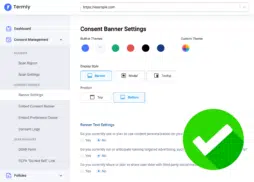
Cookie Consent Banner
Your AI company’s website will also need a cookie consent banner, and it must be properly configured for your users depending on which laws apply.
Look for cookie banners that have regional consent settings available, particularly for regions like Europe which is protected by the GDPR and the ePrivacy Directive, and certain U.S. states like California, which is protected by the CCPA.
This feature helps ensure your users automatically see a banner with the proper Accept, Reject, and/or Customize buttons and links based on the law that protects them.
Cookie Preference Center
Most privacy laws explicitly state that website users must be able to change their minds and remove their consent easily at any time. Having a preference center on your site is a simple way to align with this requirement.
The preference center can be linked to your cookie consent banner and to the footer of your website. This way, users can always easily access it even after the banner disappears.
Consent Logs
Under data privacy laws, your AI company is responsible for proving that you’ve obtained adequate, legal consent from your users to place cookies on their browsers.
It’s therefore important that you’re able to maintain proper consent logs in case an audit from a supervisory authority ever occurs.
Similarly, if you receive a complaint or an enquiry from a user, you should be able to demonstrate how and when you obtained their data.
Most reliable CMPs offer consent logs as a feature for this very reason.
Privacy Policy
Your AI company should take this time to ensure that your privacy policy is also updated and is easily available to users wherever data collection occurs.
The policy should be clear, accurate and easy to understand.
There should be a cookie section in your policy, explaining how your website handles cookies and other similar trackers, and it should feature a link that leads directly to your cookie policy.
Some companies choose to link their privacy policy to their cookie consent banner as well.
Additional Considerations
When setting your AI company website up for cookie consent, there are a few additional considerations to keep in mind:
- Ensure your users can follow through on their opt-out rights: Some laws, like several U.S. state-level privacy laws, give users the right to opt out of direct advertising including through the deployment of internet cookies.
- Be prepared to honor browser opt-out signals: Some privacy laws, including the CCPA and the CPA, require websites to honor browser opt-out settings set by technology like Global Privacy Controls.
How Does Termly Help AI Startups and Companies with Cookie Consent?
AI startups and companies can look to Termly’s Consent Management Platform for help aligning their website with different regional privacy laws.
Our legally backed CMP is configurable to meet opt-in and opt-out requirements in over 80 regions around the globe. Some of the top features include:
- Consent banner
- Cookie policy
- Website canner
- Consent preference center
- Cross domain consent
- Embeddable DSAR form
- Script auto-blocker
- Custom banner styles
- Consent logs
- Multi-language supports
Our tools also include AI-specific details, like a clause in your privacy policy where you can list all AI platforms or tools you use.
There’s a reason why thousands of AI startups and companies are already using Termly.
Try it out for free today and see why for yourself!

Written by Natasha Piirainen
Natasha Piirainen is a privacy writer with a Bachelor’s Degree in English and Philosophy from Wheaton College and over 10 years of professional experience in research-driven content development.
Read all posts by Natasha Piirainen
Reviewed by James Ó Nuanáin, CIPP/E, CIPM, CIPT
James Ó Nuanáin is an Information Privacy Professional with a Bachelor of Laws (LLB) from the National University of Ireland and a Master of Laws (LLM) from Leiden University in 2016.
Read all posts reviewed by James Ó Nuanáin, CIPP/E, CIPM, CIPT