

Does your Software as a Service (SaaS) business have a clear privacy policy explaining how you handle personal data?
SaaS companies often process personal information to deliver seamless services. With that responsibility comes the need to be transparent about your practices.
In this guide, I cover how to make a privacy policy for a SaaS business, the essential sections to include, and how to make one that reflects your data practices.
- How Can I Make A Privacy Policy For My SaaS Business?
- What Is a Privacy Policy?
- What Is a SaaS Business, and Why Does It Need a Privacy Policy?
- Does Your SaaS Business Legally Need a Privacy Policy?
- What Are the Benefits of Having a Privacy Policy for Your SaaS Business?
- What Should You Include in Your SaaS Privacy Policy?
- Where Should You Display Your SaaS Privacy Policy?
How Can I Make A Privacy Policy For My SaaS Business?
First, let’s go over the ways to make a privacy policy for your SaaS business.
Use a Privacy Policy Generator
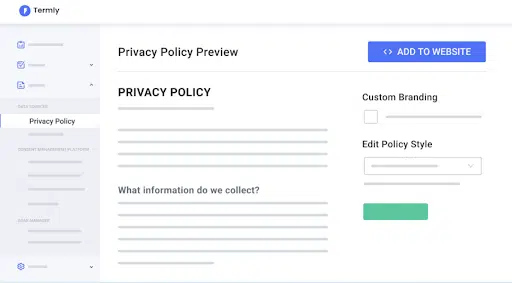
The fastest, easiest way to make a privacy policy for your SaaS website is to use Termly’s free privacy policy generator.
It includes provisions to help you meet the requirements of various data privacy laws, and it’s vetted by our legal team of privacy experts, who regularly update it to account for new legislation.
The generator asks simple questions about your business and its data processing activities, then makes a unique policy based on your answers.
Not only are our solutions legally backed, but Termly is also committed to protecting the privacy of our users.
With Termly, you get a privacy partner you can genuinely trust.
Use a Privacy Policy Template
You can use Termly’s free privacy policy template to create a quick, legally sound document. It includes standard clauses and language that align with several major data privacy laws.
Just customize the sections with details about your SaaS business, remove any that don’t apply, and add new ones if needed.
Write Your Own Privacy Policy
If you prefer to write your policy from scratch, you’ll need to understand your data practices and the privacy laws that apply to you.
Because SaaS platforms process data continuously, the policy must be especially clear and detailed. If you’re not familiar with privacy laws, it’s easy to miss essential clauses, which can create legal risk.
Check out our guide on how to write a privacy policy if you decide to take this route.
What Is a Privacy Policy?
A privacy policy is a legal document that explains how your business collects, uses, shares, and protects personal information.
It tells users:
- What personal data you collect
- How and why you use that data
- Whether you share it with third parties
- What rights users have over their information
- How they can act on those rights
- For how long you will retain their data or
- How you protect their data
Many privacy laws, including the GDPR, the CCPA, and others, legally require businesses to publish one for transparency reasons.
Even when it’s not mandated, users expect to find a privacy policy because it is considered to show transparency and builds trust.
What Is a SaaS Business, and Why Does It Need a Privacy Policy?
SaaS (Software as a Service) is a model where software is delivered online rather than installed locally on a user’s device. Customers typically subscribe on a recurring basis, and the software is hosted on secure remote servers.
SaaS tools power everything from project management and customer support to accounting and marketing automation. Because these platforms continuously collect and process personal data, from sign-up details to payment information and integrations, they fall under the scope of major privacy laws.
A privacy policy for SaaS is essential because it:
- Ensures compliance with data privacy laws like the GDPR, CCPA, and others.
- Explains data handling practices around accounts, billing, integrations, and analytics.
- Builds trust by showing users how you protect their information.
Without one, SaaS businesses risk fines, reputational damage, and losing customer confidence and trust.
Does Your SaaS Business Legally Need a Privacy Policy?
Because SaaS platforms collect and process personal data from users around the world, they’re often subject to multiple privacy laws at once.
The specific rules that apply depend on where your users are located, not just where your company operates.
Some of the most common laws affecting SaaS businesses include:
- General Data Protection Regulation (GDPR): Applies to any company that handles data from individuals in the EU or EEA. Requires explicit consent, lawful processing, and transparency about user rights and international data transfers.
- California Consumer Privacy Act (CCPA): Governs how businesses collect, use, and sell personal data from California residents. Gives users the right to access, delete, or opt out of the sale or sharing their data and requires a privacy notice that explains these rights and how to use them. The California Privacy Rights Act (CPRA), which took effect in January 2023, significantly expanded the CCPA by introducing new categories for sensitive personal information, creating the California Privacy Protection Agency, requiring risk assessments, and establishing stricter rules for contractors versus service providers.
- Virginia , Colorado, and other U.S. state privacy laws: Several states now have their own regulations with similar disclosure and opt-out requirements, including rights to access, delete, correct or opt out of targeted advertising or the sale of personal information. SaaS businesses serving U.S. customers must keep up with these emerging frameworks in order to also meet their high standards.
- Other global laws: Regions like Canada (PIPEDA), Brazil (LGPD), and China (PIPL) also impose privacy policy obligations.
A compliant privacy policy helps your SaaS business meet these obligations by informing users what data you collect, why you collect it, and how they can exercise their rights. If your platform has an international user base, it’s safest to follow the strictest applicable standards.
What Are the Benefits of Having a Privacy Policy for Your SaaS Business?
Posting a privacy policy on your SaaS platform can benefit your company in multiple ways, and legal compliance is only one example.
Legal Compliance
A privacy policy can help ensure your SaaS business meets the requirements of any applicable global data privacy laws.
Because SaaS platforms process personal data across accounts, subscriptions, and integrations, failing to include the proper disclosures could expose your company to penalties, even if violations are accidental.
A clear privacy policy reduces this risk by documenting your practices up front.
How To Ensure My SaaS Product Complies With Data Privacy Laws
It’s important you ensure your SaaS products fully comply with all applicable privacy laws.
Some steps you can take to help simplify compliance include:
- Adding an honest, transparent privacy policy to your website,
- Only collecting necessary data disclosed to users in your privacy policy,
- Obtaining adequate consent from consumers to collect and use their data,
- Ensuring you have a means to receive and respond to user requests to follow through on their privacy rights,
- Performing data protection assessments when or if necessary.
Boosts Business Reputation
Having a privacy policy makes your SaaS company look more professional and reliable.
B2B and B2C customers want to know how their data will be used before they sign up.
Displaying your policy shows that you take privacy seriously, which can set you apart from competitors who appear less transparent.
Enhances Customer Trust
Trust is critical for SaaS companies that rely on recurring revenue.
When customers can easily find your privacy policy, they’re more confident in sharing information such as billing details, account credentials, or integration access.
That trust helps reduce churn and encourages long-term relationships with your platform.
Improves Coordination With Third-Party Tools
Most SaaS platforms integrate with external services, such as payment processors, CRMs, or analytics providers.
These partners often require you to have a published privacy policy before you can use their features. Maintaining an up-to-date policy ensures smooth onboarding and compliance with their terms of service.
Supports International Growth
If your SaaS company serves users across multiple regions, a privacy policy makes global expansion easier.
It shows international customers that you respect their rights under local laws, whether they’re in Europe, California, or beyond.
By proactively addressing international data transfers, you reduce friction with users and regulators as you scale.
What Should You Include in Your SaaS Privacy Policy?
A SaaS privacy policy should be transparent and easy to navigate. It should explain what data you collect, why you collect it, and how users can control their information.
Because SaaS platforms process data in multiple ways, through accounts, integrations, and analytics, clarity and structure are especially important.
Below are the essential sections every SaaS privacy policy should cover.
Data You Collect
Your privacy policy should clearly explain what types of data your SaaS platform collects and how it’s obtained.
You can organize this section into categories such as:
- Personal information: Names, email, billing details, etc.
- Usage data: Activity logs, interactions, preferences, and support requests.
- Technical data: IP addresses, browsers, device ids, and operating systems.
- Tracking data: Cookies, analytics tools, and similar technologies that monitor user behavior.
- Third-party data: Information shared through integrations with CRMs, payment gateways, or marketing tools.
Be transparent about whether data is collected directly from users, automatically through your platform, or received from partners.
How and Why You Use Data
Your privacy policy should explain how the data you collect supports your SaaS product and user experience.
Be specific about each purpose, so users understand why their information is needed. Common reasons include:
- Account management: To create and maintain user profiles or subscriptions.
- Service delivery: To provide core features, process payments, or integrations.
- Product improvement: To analyze usage trends and enhance performance.
- Security/fraud prevention: To detect unauthorized activity or protect accounts.
- Marketing and communication: To send updates or offers with clear opt-outs.
- Legal compliance: To meet tax, record-keeping, or contractual obligations.
Under the GDPR, you’ll also need to identify your legal bases for processing
personal data. You can learn more about these requirements in our guide to the six legal bases for processing personal data.
Data Sharing and Third Parties
SaaS platforms often depend on external vendors to operate effectively. Your privacy policy should name or describe the categories of third parties that may access user data.
Examples include:
- Hosting and infrastructure providers (e.g., cloud servers).
- Payment processors that handle billing details.
- Analytics and marketing tools that track engagement.
- Customer support and communication platforms.
Clarify that these partners process data only as needed to perform their functions and are bound by security terms.
International Data Transfers
If your SaaS business serves global users, you must explain how data is transferred and stored across regions.
Your users should know whether their information may be processed outside their home country, so include:
- The regions where your servers or third parties are located.
- The safeguards you use when transferring data across borders, such as Standard Contractual Clauses (SCCs) for transfers from the EU or UK, Data Processing Agreements (DPAs), or participation in the EU–U.S. Data Privacy Framework, when transferring data between the EU and the United States.
- How users can contact your business for questions about international transfers.
Transparency about cross-border data flows builds trust and helps satisfy requirements under laws such as the GDPR and the UK GDPR.
What If Your SaaS Acts as a Processor for Your Customers?
Many SaaS platforms handle personal data in two different roles:
- As a controller, for data like your own website analytics, user accounts, and billing details.
- As a processor, for data that your business customers upload or send to your service about their own users or employees.
Your public privacy policy normally describes how you use data where you act as a controller.
When you process data as a processor on behalf of your customers, your obligations are mainly set out in your contracts with them (for example, in a Data Processing Agreement or Data Processing Addendum).
You can briefly explain this in your privacy policy by:
- Stating that certain data is processed solely on your customers’ instructions, and
- Noting that, for that data, the customer’s own privacy notice will apply and your role is limited to providing the service as described in your contract.
Data Retention and Deletion
Outline how long you keep user data and why. Retention periods may vary depending on the type of information and your legal or operational needs.
Your policy should explain:
- How retention times are determined.
- What happens when users delete their accounts or stop using the service.
- Circumstances that require retaining specific data for longer periods, such as fraud prevention or legal compliance.
Include a straightforward process for users to request deletion or closure of their accounts.
User Rights
Privacy laws like the GDPR grant individuals specific rights over their personal data.
Common rights include:
- Access: Requesting a copy of their personal information.
- Correction: Updating or fixing incomplete or inaccurate data.
- Deletion: Asking for data to be removed where legally permitted.
- Restriction or opt-out: Limiting how their data is used, such as for marketing or analytics.
- Data portability: Requesting their information in a structured, readable format.
- Objection: Opposing certain types of processing, including direct marketing.
- The right to withdraw consent: Where you rely on consent as your legal basis (i.e., for certain marketing or analytics activities), users can withdraw that consent any time without affecting the lawfulness of processing based on consent before its withdrawal.
- The right to lodge a complaint: Users in jurisdictions like the EU, UK, Brazil, or China have the right to lodge a complaint with a data protection authority or other regulator if they are unhappy with how their data is handled.
If your SaaS business “sells” or “shares” personal information under California or other U.S. state privacy laws, your privacy policy should clearly state this and explain how users can opt out of such processing.
This may include providing a “Do Not Sell or Share My Personal Information” link and honoring browser-based opt-out signals, like Global Privacy Control, where required.
Your privacy policy should outline these rights and explain how users can exercise them.
Include a simple way for users to submit requests, such as a contact email or secure online form, and explain how your team will verify and respond to them.
Security Measures
Users want reassurance that their data is protected. Briefly outline the technical and organizational measures your SaaS company uses to safeguard information.
Examples include:
- Data encryption in transit and at rest.
- Role-based access control for employees.
- Regular security audits and monitoring.
- Incident response procedures in case of a breach.
Avoid guarantees, just emphasize your commitment to maintaining appropriate protections.
Cookies and Tracking Technologies
If your SaaS product uses cookies or similar tracking tools, disclose that clearly. Explain what these technologies do and how users can manage their preferences.
You might include:
- The types of cookies you use (essential, functional, analytics, marketing).
- Why they’re used (e.g., remembering logins or measuring usage).
- A link to your standalone Cookie Policy for more details.
This transparency is required under laws such as the ePrivacy Directive and the GDPR.
Equally important, if you serve users in the EU or UK, you may also need a separate cookie banner and cookie policy that let users give or refuse consent for non-essential cookies, in line with the ePrivacy rules and the GDPR.
Policy Updates
Privacy laws and business practices change over time. Your policy should note how updates will be communicated to users.
State that you’ll post revisions on your website or notify users by email or in-app message when significant changes occur.
Encourage users to review the policy periodically to stay informed.
Contact Information
End your privacy policy with a simple way for users to reach you. This helps build trust and ensures compliance with global laws.
You should provide:
- Your business name and contact email.
- Physical mailing address (if applicable).
- Contact details for your Data Protection Officer (DPO) or privacy team, if you have one.
Providing transparent contact options shows that your company takes privacy seriously by offering users a direct line of communication if they ever have questions about their data.
Where Should You Display Your SaaS Privacy Policy?
Once you’ve created your privacy policy, make sure users can easily find it. Most privacy laws require that it be clearly accessible wherever personal data is collected.
For a SaaS business, this often means linking your policy in places like:
- In your website footer. This ensures the policy is always accessible, whether visitors are learning about your service or browsing support content.
- On sign-up or onboarding pages. Since users provide personal details when creating an account, include a link to your policy at this stage.
- On checkout or subscription pages. Recurring billing requires handling payment data, so give users a chance to review your practices before completing a purchase.
- Within your app or dashboard. SaaS customers often log in regularly, so make your policy easy to find in settings or account menus.
- Wherever marketing data is collected. If you run email capture forms or integrate CRM tools, include your policy so users know how their data will be stored and used.
Strategically placing your privacy policy across these touchpoints not only helps with compliance but also reinforces to customers that your SaaS company takes data protection seriously at every step.

Written by Hanna De La Garza
Hanna De La Garza is a privacy writer at Termly with a Bachelor’s Degree in Journalism from the University of Florida. She creates engaging resources on data privacy, consent management, regulatory updates, and more.
Read all posts by Hanna De La Garza
Reviewed by Teodor Stanciu, CIPP/E, CIPM
Teodor Stanciu is a Legal Coordinator & DPO with a Bachelor’s Degree in Law from the University of Bucharest and a Master of Laws in EU and International Business Law from Radboud University.
Read all posts reviewed by Teodor Stanciu, CIPP/E, CIPM