

Next.js is an open-source framework that enables people to build full-stack applications that are capable of collecting and processing various kinds of personal information from website visitors.
While Next.js does not collect personal data by default, deploying your site on Vercel may involve sharing certain personal data with Vercel as your hosting provider.
Because of the ways a website or web app collects and uses personal data, businesses relying on Next.js will likely need to make a privacy policy explaining specific details about when, how, and why user data is collected.
Below, I outline everything you need to know about making a privacy policy for Next.js, including how to make one and why you need it, what laws impact it, what details should go into it, and more.
Creating a Privacy Policy for Next.js
Here are three easy ways you can create a privacy policy when you use Next.js.
Use a Privacy Policy Generator
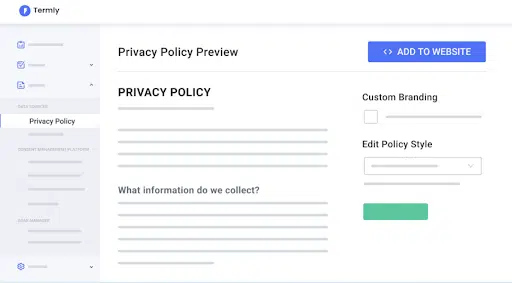
The simplest way to make a privacy policy when you use Next.js is to use Termly’s free Privacy Policy Generator.
Our legally backed solution asks easy questions about your business to help you align with applicable laws and makes a unique policy based on your answers that you can embed directly on your site.
Not only are our solutions legally backed, but we’re also fully committed to protecting the privacy of our users.
With Termly, you get a privacy partner you can genuinely trust.
Use a Privacy Policy Templates
If you use Next.js to build out your site, you can also try Termly’s free privacy policy template to make a custom agreement for your business.
When using a template, fill in the blank sections with unique, accurate details about your business and how it collects, processes, and uses personal information.
Be sure to take extra time to remove any clauses that might not apply to you and add any other details as necessary.
Write It Yourself
You can also write your own privacy policy for your website, but you should only do so if you have a lot of technical knowledge and a strong understanding of data privacy laws.
It’s important that you’re extra thorough, especially about any third-party services your business uses and what data is shared with them, including Next.js.
You might even consider consulting a privacy lawyer or attorney to review the document.
Because these are legal documents impacted by privacy laws, your site could be held accountable if you accidentally leave something out or make a mistake.
How NOT To Make a Next.js Privacy Policy
Now that you know some easy ways to make a privacy policy, I want to briefly cover some options to avoid.
- Don’t copy another business’s privacy policy. These are protected by copyright law, so copying one may amount to plagiarism, which is illegal. Another business’s policy will not accurately account for how your business collects and processes personal data. Businesses just shouldn’t take this risk.
- Don’t use AI to generate a privacy policy. AI is exciting, but it may not be the most effective tool to make legal policies, especially when they need to include nuanced, personalized information about how you collect, process, and use personal information. An AI has no way of knowing all of these specific details, and it might hallucinate or include falsities in your policy. It’s best to use a privacy solution or consult a lawyer and privacy experts.
- Don’t use an insecure or unreliable ‘generator’ or ‘template’. Avoid using generators that claim to cover privacy laws but actually don’t, generators that up-charge for common features typically included even in free templates, and generators that are never updated or maintained by a legal team or data privacy experts. There are better, reliable options out there, like Termly!
Privacy policies are not a one-size-fits all document. They are living policies that must adapt with your business.
Being lax about the contents of your policy and using workarounds like an LLM or an insecure “free” tool that’s too good to be true can put your business at risk.
You might face fines for violating privacy laws, causing irreparable harm to your brand’s reputation and losing consumer trust.
Do I Need a Privacy Policy If I Use Next.js?
Yes, many Next.js users might legally need to have a privacy policy, particularly if your business falls under any consumer data privacy laws like the GDPR, the CCPA, or others.
But having a privacy policy is more than a legal issue. It also shows internet users that your website is safe, secure, and reliable.
Presenting your users with a privacy policy lets them know exactly what you do with their data, and this transparent communication helps increase trust.
Laws That Impact Next.js Privacy Policies
There are several laws that might impact your business, especially if you’re using Next.js or any other full-stack web application platforms that process personal data.
For example, these laws might apply to your business based on factors like where you are located, where your users come from, and how much and what kind of data you collect:
- EU General Data Protection Regulation (“GDPR”), and E-Privacy Directive
- California Consumer Privacy Act
- Australia Privacy Act 1988
- UK General Data Protection Regulation (“UK GDPR”) and the PECR
- New Zealand Privacy Act 2020
- South Africa Protection of Personal Information Act
- U.S. state-level consumer privacy laws
Information to Include in a Next.js Privacy Policy
To help businesses with Next.js websites make a privacy policy, I’ve summarized the most common clauses that appear in these necessary legal documents.
What Data You Collect
Your privacy policy must explain what data you collect from users, including any information you share with Next.js.
You should list this information in a clear format, so it’s easy for users to read and understand, like in a bullet list or a neatly organized table.
Why You Collect the Data
Your privacy policy must also clearly explain the purpose behind each specific data processing activity that you want to perform.
For example, if you collect customers’ email addresses to send marketing communications, your policy should explain that this data is used for promotional purposes.
Likewise, where you collect credit cards or billing details, you should specify that this information is used to process payments.
Legal Basis You Rely On
Under certain data privacy laws, your privacy policy also must explain the legal bases you rely on to justify collection and processing of personal data.
The EU and the UK GDPR require that you rely on one of the six legal bases to process personal data. These legal bases include consent, contractual necessity, and legitimate interest.
How You Collect The Data
Explaining how you collect personal data is another legally required clause that belongs in your privacy policy, especially if you build your parts of your site using Next.js.
For example, you need to explain if you collect data:
- Directly from the consumer
- Through the use of automated technologies, including cookies, trackers, and plugins
- From publicly available information
- Through social media
- Through forms on your website
- Through sign-up forms
- In person flyers or paperwork
- Third-party data suppliers
- In any other way
Third Party Data Sharing Clause
Since you’re using Next.js to build aspects of your site, there’s a good chance you’re sharing personal data with different service providers about your website visitors.
Add a clause to your privacy policy explaining this and mention any third-party entities you sell or share information to.
Privacy laws require you to clearly state the categories of data you share with third parties, and what categories of third parties you share the data with.
Consumer Rights Over Their Data
You also need a clause in your privacy policy that explains what rights consumers have over their personal data and how they can act on those rights.
Make sure you can lawfully access any information shared with your Next.js applications so you can help users follow through on their right to access, correct, or delete their data.
This is required under several U.S. state level privacy laws, like the CCPA, and by the GDPR.
If multiple laws apply to your site, consider having multiple clauses for each one to make it extra easy for your users to find the right information that applies to them.
Children’s Data Clause
Your privacy policy should also have a children’s data clause; this is necessary even if you don’t actually target children.
For websites that don’t sell to children, this clause should explain how legal guardians can contact you if they believe you’ve accidentally collected information from their child.
This is necessary because children might use the internet without supervision, and there’s a chance they may accidentally end up on your site or give their data to a Next.js application.
If your website is oriented towards children, there are other strict laws in place to protect minors that you’ll need to follow, like the Children’s Online Privacy Protection Act (COPPA).
Cookies and Other Trackers
If your website or any of your Next.js applications use cookies, which it most likely does, then you must disclose this to internet users and include a clause in your privacy policy that links to your official updated cookie policy.
Privacy laws like the GDPR and the CCPA consider cookies to be a form of personal data, so using them falls under the scope of privacy laws.
Company Contact Information
Finally, make sure there’s a clause in your privacy policy that provides contact information for your business so users know how to contact you if they have privacy questions or concerns.
This is a requirement outlined by privacy laws like the GDPR.
Where to Display Your Next.js Privacy Policy
Display your website’s privacy policy in a few prominent places across your site, for example:
- Website footer: This is an ideal place to post a privacy policy because it’s a static part of your website, so users can always access it.
- Payment screens: Payment portals often collect personal data from consumers, so post your privacy policy there so they can read and agree to it.
- Account creation pages: If users can create accounts on your Next.js site, include a link to your policy, so they know how you use their data when they create a login.
- Wherever data collection occurs: A rule of thumb is to post a link to your privacy policy before or at the point of data collection, which aligns with laws like the GDPR.
- Email and SMS Communications to Individuals and Businesses: When contacting individuals or businesses via email, SMS, WhatsApp, or other messaging platforms, you must ensure that your communications include clear access to your privacy policy. This allows you to inform recipients about how you collected the information and how you use the information.
How Termly Helps
When you use Next.js to make full-stack web applications, it’s important to clearly and accurately communicate the ways these interfaces collect and process personal data from your website visitors.
Tools like Termly’s privacy policy generator make it much easier to have a customized document for your site, and you can easily update it as needed.
Backed by our legal team and data privacy experts, it asks simple questions about your site, and makes a unique policy based on your answers. Try it today for free and see why millions of users trust Termly.

Written by Natasha Piirainen
Natasha Piirainen is a privacy writer with a Bachelor’s Degree in English and Philosophy from Wheaton College and over 10 years of professional experience in research-driven content development.
Read all posts by Natasha Piirainen
Reviewed by Ali Talip Pınarbaşı, CIPP/E, & LLM
Ali is a London-based Data Privacy Law Solicitor with a Master of Laws Degree in EU Privacy law at King's College London. He has six years of experience in advising businesses on how to comply with data protection laws.
Read all posts reviewed by Ali Talip Pınarbaşı, CIPP/E, & LLM