

AI startups and companies typically collect personal information from website visitors and customers in order to train and develop AI models, deliver services, and improve the overall user experience.
AI requires massive datasets to function properly, and often this data is regulated under data privacy laws that require your AI startup or company’s privacy policy to make certain disclosures to individuals about the use of their personal data.
Under the applicable privacy laws, this document must explain how your AI business collects, uses, stores, and shares personal information.
Keep reading to learn all about making a privacy policy for an AI startup, what it should include, and how to ensure it aligns with applicable laws and regulations.
- How To Create a Privacy Policy for AI Startups and Companies?
- Do AI Startups and Companies Need a Privacy Policy?
- What Laws Impact AI Startup Privacy Policies?
- Do AI Companies Use Data to Train Models?
- What Information Should Be Included in an AI Startup Privacy Policy?
- Where Should I Display My AI Startup Privacy Policy?
- How Does Termly Help AI Startups with Privacy Policies?
How To Create a Privacy Policy for AI Startups and Companies?
There are several ways you can reliably make a privacy policy for your AI startup.
Use a Privacy Policy Generator
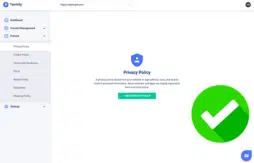
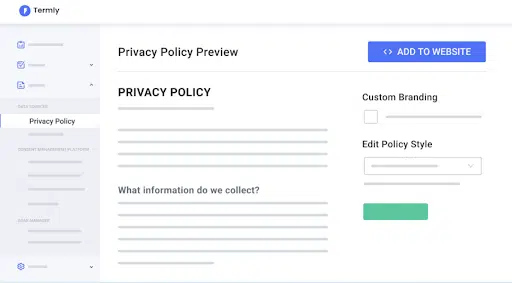
One of the easiest ways to make a privacy policy for your AI startup or company is to use Termly’s free Privacy Policy Generator.
There’s a reason why over 6,000 AI businesses trust using Termly to help make a privacy policy and manage user consent.
Backed by our legal team and data privacy experts, it asks simple questions about your business, its data processing activities, and how that data interacts with your AI product.
It uses your answers to make a unique policy you can easily embed directly on your site.
At Termly, we also pride ourselves on transparency and trust and are fully committed to protecting the privacy of our users.
Use a Privacy Policy Template
You can also use a privacy policy template to make this legal document for your AI business.
This takes a little more effort on your part, as you’ll have to manually fill in blank sections of the template with accurate details about your AI startup or company and how it processes and uses personal data.
However, it completes all the formatting and structural aspects for you, so you can quickly and easily make a privacy policy and add it to your site.
Write It Yourself
Finally, you can also write your own privacy policy for your AI startup or company, just ensure you have adequate legal and technical knowledge to do so accurately.
If you leave anything out, even by accident, data privacy laws and supervisory authorities can still hold your AI business legally accountable.
It could lead to fines for noncompliance, the cessation of all data processing, and damage to your brand’s reputation.
How NOT To Make a Privacy Policy for AI Startups
Now that you know how to make a privacy policy, here are a few things to avoid:
- Don’t rely on an AI or LLMs: You understand the complexities and nuances of AI, so it shouldn’t surprise you to learn that AI cannot make you an accurate privacy policy unless you heavily edit the final document to the unique circumstances of your data processing activities. These policies are very nuanced and specific to your day-to-day online and offline data processing activities. For example, businesses collect different categories of personal data through cookies, SDKs, and similar technologies; rely on different legal bases under applicable laws; and process varying volumes and types of personal information to train, develop, and fine-tune AI and machine-learning models.
- Don’t pay for ‘generators’ that are comparable to free templates: If a privacy policy generator tries to charge a fee for something that other companies give away for free, it’s best to avoid it. For example, charging a business extra just to add an essential clause that lists the data you collect might be a red flag.
- Don’t be dishonest or leave anything out: If your privacy policy is incomplete or missing information, your company can be held legally accountable. Make sure your final policy is very thorough, accurate, and meets the requirements of all laws that impact your business and consumers.
Do AI Startups and Companies Need a Privacy Policy?
Yes, under all major data privacy laws like the GDPR and the CCPA, most AI startups and companies need to publish a compliant, honest privacy policy.
If your AI products or site collects any personal information from individuals, it’s likely that a privacy law applies to that data and requires you to inform your users about your data practices.
Some examples of when AI companies process personal data include the following:
For AI companies, personal data could be embedded in training data, prompts, or even AI outputs. These companies face increased scrutiny from privacy laws and regulations worldwide.
Having a compliant privacy policy helps you meet transparency guidelines and overall reduce your legal risks.
What Laws Impact AI Startup Privacy Policies?
Most major privacy laws require businesses to publish a privacy policy when they collect personal information, and this applies to AI startups and companies.
Some regulations that might impact your AI startup include:
These laws exist around the world and typically outline obligations for businesses to explain what data they collect, why they process, what legal basis justifies the processing of data and how users can exercise their privacy rights such as right to deletion of their personal data.
It’s important to note that while it doesn’t impact your privacy policy, your AI company might be subject to complying with the EU AI Act, which outlines additional transparency guidelines.
Do AI Companies Use Data to Train Models?
Yes, AI companies typically use personal data to train or improve models, and this must be clearly disclosed to consumers directly in your privacy policy.
Therefore, it’s important that your privacy policy outlines the following details to consumers:
- If user data is used for AI model training,
- For what purposes you process user personal data to train, develop, or fine-tune AI,
- What legal bases you rely on, such as consent of users or legitimate interests,
- What safeguards you have in place to protect that data, such as pseudonymization,
- And, when applicable, how users can opt out of use of their data for AI model training.
For AI startups and companies, transparency and honesty are key.
Not only do consumers appreciate this, but it’s also now required by regulators and laws like the EU AI Act.
What Information Should Be Included in an AI Startup Privacy Policy?
Your AI company’s privacy policy should clearly outline how you handle personal data throughout the entire lifecycle of the data, from the initial data collection to deletion of the personal data.
While your specific policy will vary depending on the laws that directly impact you, most privacy policies for AI entities contain the following clauses.
What Data You Collect
Your AI company should list all personal data collected directly and indirectly from users through system interactions, which might include:
- Names
- Email addresses
- Account credentials
- Payment or billing information
- User inputs, like prompts or uploaded content
- Profile and account metadata, such as preferences or settings
- Device data, including IP addresses or log files
- Usage data or interaction metrics and analytics
- Inferences or derived data generated by the AI system
You should be transparent, accurate, and very thorough in this clause and state if any inputs are stored, analyzed, anonymized, or if you use them in any way to improve your services.
Why You Collect the Data
Your AI company’s privacy policy should explain why you’re collecting personal data from consumers, as required by laws like the GDPR and the CCPA.
Some examples of why you collect data may include any of the following:
- To provide and maintain AI-powered services,
- To train, improve, or fine-tune AI models,
- To monitor performance or prevent misuse,
- To communicate with users,
- To process payment or subscriptions,
- To enforce your intellectual property rights and to enforce your legal rights
- To prevent fraud and misuse
- To meet legal or regulatory obligations.
Ensure your reasoning for why you collect personal data remains in line with all applicable laws and regulations.
How You Collect the Data
Under laws like the GDPR and the LGDPA, entities must explain how you collect personal data from protected consumers.
You might obtain user consent to gather the data, or it might come from prompts inputted by the users, or forms on your website.
Alternatively, you might collect personal data via indirect means, such as through automated tools like cookies and similar technologies or from third parties like data suppliers.
List all ways very clearly so your users are properly and lawfully informed.
Third Party Data Sharing
It’s common for AI startups or companies to rely on third-party services, and this relationship often involves sharing consumer personal information with the outside entities.
Your privacy policy should identify the types of third parties you share data with and explain why it’s shared.
For example, like any other business, AI companies might use cloud hosting providers, analytics platforms, payment processors, and customer support tools that process lawfully protected customer details.
Consumer Rights Over Their Data
Your users might have the following rights over their data, depending on which laws apply:
- Access their data
- Request to correct their data
- Request to delete their data
- Opt out of certain data processing
- Right to data portability
- Restrict certain data processing
- Withdraw consent for data processing
Under laws like the GDPR and the CCPA, you must inform your users of these rights in a clause in your privacy policy.
AI companies must also ensure your users can easily follow through on these rights in a lawful manner; this includes any data fed to or used to train your AI.
Children’s Data Clause
If you collect and use children’ personal data, your privacy policy should include a section explaining how you handle this data.
If your AI company doesn’t collect children’s information, use this space to explain how legal guardians can contact you if they believe you’ve accidentally gathered details about their child.
If you do, you are subject to following additional strict laws like the Children’s Online Privacy Protection Act (COPPA).
Data Retention Clause
Privacy laws limit how long companies can retain data, and your privacy policy should explain this process clearly to consumers.
AI startups should include the following details:
- How long you store personal data, or your criteria for determining applicable data retention periods
- Whether the retention depends on account status or legal obligations,
- How that data is securely deleted or anonymized.
Cookies and Other Trackers
AI companies are also like any other business in that your website most likely uses cookies or other technologies, which are regulated by certain major privacy laws such as the ePrivacy Directive and the GDPR
You should have a section in your privacy policy explaining if and how your website uses cookies and similar trackers and add a link to your stand-alone cookie policy when necessary.
Data Security Clause
Under data privacy laws like the CCPA and the GDPR, you’re responsible for protecting the personal data you collect.
It is recommended that your privacy policy disclose minor security details to consumers, without giving away too much essential information, including:
- If you encrypt the data,
- If access controls are implements,
- Network or infrastructure safeguards,
- Regular monitoring and updates.
Updates to Your Privacy Policy
Explain in a clause in your privacy policy how you communicate to users when any material changes were made.
Under certain privacy laws like the CCPA, you must update your policy at least once every twelve months.
You might explain how changes will be communicated, when the updates take effect, and information about how users can review the revised terms.
You should also have a ‘Last Updated’ date somewhere in the header of your final privacy policy.
Company Contact Information
It’s important to include your company contact information in your AI startup privacy policy.
Not only does this ensure consumers can reach you if they have questions or comments about your policy, but it’s also required by laws like the GDPR.
Include a working email address, mailing address, or phone number somewhere in your policy that’s easy for consumers to find. It’s common to appear as the final clause.
Where Should I Display My AI Startup Privacy Policy?
AI startups should post their privacy policy in multiple places where consumers can easily find it, including:
- Website footer,
- Account sign up or registration pages,
- Payment screens,
- Below prompt inputs,
- In mobile apps, when applicable,
- Within product dashboards,
- Within SaaS onboarding flows,
- Wherever data collection occurs.
How Does Termly Help AI Startups with Privacy Policies?
For AI companies, making a privacy policy can feel like an overwhelming or confusing task, especially with the complex privacy laws and AI regulations still forming around the globe.
You’re operating in a rapidly evolving regulatory environment, which makes having an accurate, honest privacy policy you can easily update a necessity.
Using resources like Termly’s Privacy Policy Generator can help AI startups and companies more easily, efficiently make a custom policy in line with applicable laws.

Written by Natasha Piirainen
Natasha Piirainen is a privacy writer with a Bachelor’s Degree in English and Philosophy from Wheaton College and over 10 years of professional experience in research-driven content development.
Read all posts by Natasha Piirainen
Reviewed by Ali Talip Pınarbaşı, CIPP/E, & LLM
Ali is a London-based Data Privacy Law Solicitor with a Master of Laws Degree in EU Privacy law at King's College London. He has six years of experience in advising businesses on how to comply with data protection laws.
Read all posts reviewed by Ali Talip Pınarbaşı, CIPP/E, & LLM