

There are different kinds of legal requirements that websites need to be aware of and follow, especially if certain laws apply to your business or protect your consumers.
Below, learn about 9 types of laws and how their legal requirements impact websites, and find some easy tips you can follow to help meet them.
- What Types of Legal Requirements Impact Websites?
- How Can Your Website Meet These Legal Requirements?
- Are There Additional Legal Requirements for Websites in Specific Industries?
- What Requirements Are Not Legally Required But Strongly Recommended
- How Can Termly Help My Website?
- Legal Requirements for Websites: Frequently Asked Questions
What Types of Legal Requirements Impact Websites?
Websites are impacted by countless different legal requirements depending on factors like what industry you work in, what type of services you perform, who your customers are, where you’re located, and more.
Here are 9 types of laws and some of the legal requirements they outline that can impact websites like yours.
| Type of Law | Summary of Legal Requirements & How To Meet Them |
1. Data Privacy Laws (GDPR, CCPA, etc) |
Data privacy laws protect personal information and outline rights for your consumers. Common requirements impacting websites include:
|
2. Cookies and Targeted Ads (GDPR, ePrivacy, etc) |
Cookie requirements are outlined by laws like the GDPR and ePrivacy Directive in Europe and by state-level privacy laws in the U.S. Common requirements vary by law but may include:
|
3. Data Security Requirements |
Laws like the GDPR protect personal data, but they also outline data security requirements and hold businesses accountable if information in your possession is breached or accessed by an unauthorized entity.
While it’s typically up to you what security measures you want to apply, common methods include:
|
4. Accessibility Requirements (ADA, WCAG, etc) |
You can follow accessibility requirements to ensure your website can be used by everybody. While implementing these standards is sometimes voluntary, you might be legally required to meet some accessibility standards depending on your industry, which might include:
|
5. Ecommerce/Payment Processing Security |
If you run an ecommerce website or process payments, you may need to meet certain requirements to adequately protect your users’ payment details, for example:
|
6. Copyright and Plagiarism Requirements |
Websites should consider following all copyright and plagiarism laws that apply, which vary by region but may include:
|
7. Content Licensing and Attribution |
Websites should practice adequate and responsible licensing and attribution protocols regarding their content. While linking to the original source might make sense in articles and blog posts, consider strengthening your citations by following requirements, such as the following.
For attribution:
Regarding licensing, it’s important to understand the common licensing types:
|
8. Anti-Spam Laws |
Anti-spam laws like CAN-SPAM impact websites that communicate to users through email or SMS. These laws typically outline requirements such as:
|
| 9. Disclaimers | Websites typically benefit from having a disclaimer page where all legal policies and disclaimers can live in one convenient location that’s easy for site visitors to find. Depending on your industry, some disclaimers may be legally required, while others are business best practices:
|
What Laws Might Apply to My Website?
There are a lot of different laws that could impact your website, and it is your responsibility to be aware of which ones apply, which may include laws or regulations such as:
- General Data Protection Regulation (GDPR): If your website is offering goods or services to those located in the European Union, Iceland, Norway, Liechtenstein, Switzerland, or the UK, you must comply with the sweeping privacy laws generated by the General Data Protection Regulation. Complying with the GDPR starts with a comprehensive privacy policy that details what, how, when, and where data is collected.
- California Consumer Privacy Act (CCPA): The California Consumer Privacy Act is a data privacy law that regulates how businesses worldwide handle the personally identifiable information of California residents. It also requires you to present a cookie policy that explains the cookies you collect and store, and how you or third parties may use them.
- California Privacy Rights Act (CPRA): In November 2020, an addendum to the CCPA was enacted that strengthened the scope and depth of California’s data privacy requirements. The California Privacy Rights Act is a powerful data privacy amendment that affects the privacy and notice requirements for websites accessible to California consumers. The CPRA expands on the CCPA.
- Children’s Online Privacy Protection Act (COPPA): The FTC enforces the Children’s Online Privacy Protection Act to protect children’s privacy and keep them safe online. COPPA regulations require websites to obtain parental consent before collecting personal information from children under 13.
- California Online Privacy Protection Act (CalOPPA): In addition to basic GDPR rules, other legal requirements for websites include complying with the provisions of California’s Online Privacy Protection Act. Your privacy policy must use the word “privacy” in a direct link from the website’s homepage and reveal third-party information regarding exactly who collects data.
- ePrivacy Directive (EU Cookie Law): The EU Cookie Law requires websites to have a dedicated cookie policy and to obtain user consent before storing or retrieving personal information on a computer, smartphone, or tablet. Designed to protect data privacy, it aims to make customers aware of how much information about them websites collect. This allows for an informed choice about whether to continue providing the information.
- Eraser Button Law: The Privacy Rights for California Minors in the Digital World Act (also called the Eraser Button Law) applies to websites that allow users under 18 to register and post content. The Eraser Button Law requires these websites to inform users under 18 that they have the legal right to remove the content they have contributed at any time.
- Americans with Disabilities Act (ADA): The Americans with Disabilities Act requires certain website accessibility standards so users with disabilities can still use your site. This means that all electronic information and technology, including your website, must be accessible to those with disabilities.
How Can Your Website Meet These Legal Requirements?
Now let’s take a closer look at the legal requirements your website might need to meet and the different ways you can align with those obligations.
How Can My Website Meet the Data Privacy Laws?
To meet the requirements outlined by data privacy laws, you’ll most likely need to implement the following:
- Publish an accurate and up-to-date privacy policy,
- Include a “Do Not Sell or Share My Personal Information” link in the footer of your website, if necessary,
- Have a way for users to submit requests to easily follow through on their privacy rights,
- Limit data collection only to what is necessary and reasonable.
Your privacy policy should include details about the type of personal information you collect from users, and:
- Define how you use and share data.
- Disclose the use of third-party services.
- Describe how users can control their data.
- Inform website users of whether and how they are being tracked.
You Can Easily Create a Privacy Policy Using Termly
Here’s how you can use Termly’s generator to create a comprehensive and compliant privacy policy.
Step 1: Go to Termly’s privacy policy generator.
Step 2: Answer a few simple prompts and questions, and go through all of the steps until you reach “Final Details.”
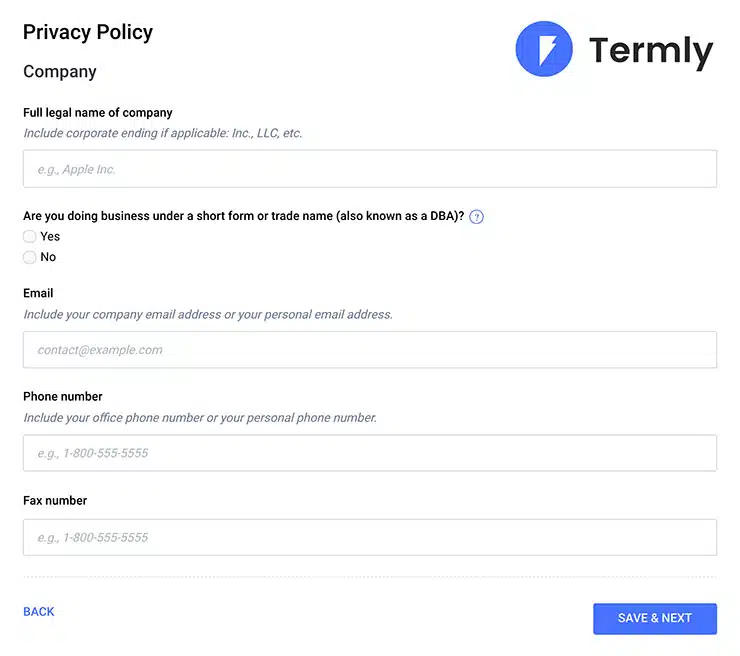
Step 3: Once you’ve filled in everything and you are satisfied with the preview, click “Publish.” You will then be prompted to create an account on Termly so you can save and further edit your privacy policy.
How Can My Website Meet Cookie and Targeted Advertising Requirements?
To meet cookie and targeted advertising requirements, your website may need the following:
- Present users with a cookie banner that collects their consent for cookies and targeted advertising, following all applicable laws and regulations,
- Have a preference center available so users can easily change their minds at any time,
- Keep logs of user consent choices following all legal guidelines,
- Present user with an accurate cookie policy.
Although laws like the GDPR and the EU Cookie Law are based in Europe, they apply to all businesses that market to consumers in the EU, regardless of the actual business location.
This means all U.S. businesses with EU customers should have a cookie policy that meets the transparency and consent requirements of the GDPR and the EU Cookie Law.
These rules require that users give explicit and informed consent before a website can process their information.
Under the CCPA, a user’s proactive consent in advance of data collection is not required, but opt-out options must be provided and honored.
Use Termly’s Website Scanner To Align With Cookie Requirements
Find out what cookies are on your website by using our online cookie scanner:
How Can My Website Meet Data Security Requirements?
Websites must employ security measures to protect your customers’ private information from unauthorized access, data breaches, loss, or other harm.
The required security measures you’ll need to have in place will depend on the amount of data you collect and its sensitivity. These measures need to be in place to lower the risk of cybersecurity breaches.
As part of the FTC’s Fair Information Practice Principles, websites must also define their security measures for protecting users’ data and deleting old data, ideally as a clause in your privacy policy.
Your website should also be secure, and you should audit your security methods regularly.
For example, HTTPS, or the secure Hypertext Transfer Protocol, should be automatically engaged. HTTP is the system used to send information between a website and a user’s web browser, with HTTPS being the secure version of that system.
This type of protection is critical for all ecommerce websites. If you choose not to use HTTPS, it could expose customers’ financial information when they attempt to make a purchase on your website.
Read our guide to learn more about how data privacy and data security are different.
How Can My Website Meet Accessibility Requirements?
Meeting accessibility requirements can mean making your website compatible with:
- Larger fonts
- Web reading tools
- Transcripts for videos
- Written descriptions of images
- Clear contrast between fonts and backgrounds
These accommodations can help everyone and ensure that no individual is discriminated against because of a disability.
You can also create an accessibility statement to keep your users aware of the efforts you’ve made to make your site more accessible, the current limitations, and your future plans.
Additionally, any website belonging to a business with at least 15 employees that is open for more than 20 weeks a year must comply with the ADA.
The ADA prohibits discrimination based on disability and requires that websites be accessible to everyone, including those with hearing or visual impairments.
Technically, the ADA does not explicitly address websites, and the courts have not consistently upheld that websites must comply. Note, however, that under Title II of the ADA, local and state government websites must be accessible to those with disabilities.
How Can My Website Meet Ecommerce/Payment Processing Requirements?
To meet ecommerce and payment-processing requirements, ensure you can protect your users’ payment details securely and sustainably.
For example, you might consider:
- PCI DSS compliance, or Payment Card Industry Data Security Standard
- Data encryption using strong SSL/TLS certificates,
- Implementing multi-factor authentication and access controls (MFA, strong passwords, etc),
- Deploying a WAF (Web Application Firewall),
- Maintaining and updating written security protocols, so your entire team is aware of their roles and responsibilities.
How Can My Website Meet Copyright and Plagiarism Requirements?
Original content is inherently copyrighted, whether or not you, as the website owner, developer, or creator, officially register your site online with the Copyright Office.
However, you can add a copyright notice to your website to clearly establish which rights you retain over the materials, which helps keep people properly informed.
Any unattributed or unauthorized use of another website’s original content will be flagged as plagiarism or copyright infringement.
This can extend to web copy that may have been borrowed from another website and images downloaded from places such as Google Images.
How Can My Website Meet Content Licensing and Attribution Requirements?
To meet content licensing and attribution requirements, be aware of common licensing types and how that content can legally be reshared, redistributed, or edited.
- CC BY (Attribution): Commercial use and adaptation allowed with proper credit
- CC BY-SA (ShareAlike): Adaptation allowed, but derivative works must be distributed under the same license,
- CC NC (NonCommercial): The content is not approved for commercial use or purposes.
- CC ND (NoDerivatives): The content can be reshared, but it cannot be remixed or built upon.
Licenses can be acquired directly through an agreement with a publisher or from a content library that has already licensed the material for use.
Professionally produced content may also be legally licensed for use on your own website. The content can include various media, such as:
- Photos,
- Videos,
- Audio content,
- Graphics,
- Infographics,
- Mixed media content,
- Music,
- Digital social media content,
- Logos,
- Drawings, and more.
At a minimum, attribution to the rightful owner should also be provided.
You can do this by applying the TASL framework, which involves including the Title, Author, Source, or Link when crediting sources.
You should also always clearly state when modifications were made to any of the content you share on your site, including if the materials or image is cropped, resized, or altered in any way.
Remain neutral in your attribution and always avoid indicating that the original creator endorses you or your content.
How Can My Website Meet Requirements Outlined by Anti-SPAM Laws?
Meeting the requirements of Anti-SPAM laws depends on where you’re located and where your customers are located. For example:
- In the US, a law called the Controlling the Assault of Non-Solicited Pornography and Marketing Act, or the CAN-SPAM law, deals with marketing emails and allows recipients to opt out of messages they don’t want.
- In Canada, the Anti-Spam Law creates a stricter opt-in system, in which customers must sign up to receive marketing emails. Unlike in the US, unsubscribing must be fast and easy.
- In Europe, the GDPR also covers spam, and its provisions are the strictest. For example, the GDPR always requires recipients to opt into marketing messages, and there’s no implied consent from people who are already your customers.
SPAM can include any unsolicited or irrelevant emails sent in bulk to a list of people. This can consist of unsolicited commercial emails that try to persuade customers to purchase something.
It also includes fraudulent messages, such as those proliferating phishing scams, lottery scams, or computer viruses.
How Can My Website Meet Disclaimer Requirements?
To meet disclaimer requirements affecting your website, create the appropriate clauses, disclaimers, or pages you need.
For example, you might use a generator to create disclaimers that help you disclose the following:
- Disclaim liability for third-party or advertiser content on your site, including affiliate links,
- State that the site’s content is for informational purposes only and not professional advice,
- Explain that users cannot use your original content without permission,
- If you have a legal website, present a disclaimer that the website does not establish an attorney-client relationship and that blog posts do not constitute legal advice.
Your disclaimers can be placed in their own section on your website as a ‘Disclaimer’ page, or they can be part of your terms and conditions agreement as separate, properly labeled clauses.
Include them wherever necessary and remember to go back and edit them as needed to ensure they remain accurate.
Are There Additional Legal Requirements for Websites in Specific Industries?
In addition to a website’s legal requirements covered above, various industries must follow specialized requirements.
What Are The HIPAA Requirements for Health Websites?
The Health Insurance Portability and Accountability Act of 1996 regulates the collection and sharing of patients’ personal health information. If your website deals with health information, you must take special care with how you collect it.
HIPAA rules and regulations consist of three major components:
- The HIPAA privacy rules
- The security of health data rules
- Rules regarding notifications for healthcare data breaches
Patients also need to be informed regarding their rights over their health care data.
The most common HIPAA violations include keeping records unsecured, failing to encrypt data, and improperly disposing of medical records.
If your website contains contact forms or uses a booking system, be sure they are HIPAA compliant.
What Are The ABA Requirements for Legal Websites?
The American Bar Association requires compliance with its ABA Model Rules of Professional Conduct, which govern what attorneys may and may not express on their websites.
For example, the legal requirements for a website created by an attorney state that they cannot:
- Say they specialize in or are experts in a particular area of law unless they hold a special accreditation from a state-regulated body.
- Make misrepresentations or unsubstantiated claims, such as how they are the best in the entire city, state, or region.
- Make promises about legal outcomes, including allusions to past settlements that imply future ones will be similar.
What Requirements Impact Financial Websites?
Financial institutions face distinct requirements for their websites because they are subject to hacking and viruses designed to retrieve customers’ financial information.
E-banking websites typically expose financial institutions to the highest risk per transaction, particularly with commercial transactions, which usually involve higher dollar amounts.
In addition to data security controls like encryption, financial websites should implement authentication processes for new and existing customers and avoid potential violations of laws requiring consumer privacy disclosures about the collection and storage of financial data.
In addition, public companies are subject to specific Securities and Exchange Commission regulations that govern when, what, and how content should be posted publicly on their websites.
What Requirements Impact Contractor Websites?
When you’re a general contractor or subcontractor, it pays for you to have your licensing credentials on prominent display on your website.
Although there appear to be no federal regulations for contractor websites, check with your state licensing board to determine whether you’re required to display your contracting license ID when advertising to customers online.
What Requirements Impact Auto Dealership Websites?
Groups like the FTC enforce legal requirements that impact auto dealerships, which can include:
- Pricing and advertising transparency disclosures,
- User vehicle disclosures regarding warranty status, buyers’ guide, etc.,
- Digital accessibility standards,
- Data privacy standards (i.e., posting an accurate privacy policy),
- Consent management tools (i.e., cookie banner, preference center, etc.).
What Requirements Are Not Legally Required But Strongly Recommended
Some policies, website pages, and disclaimers are not necessarily legally required, but it is a good idea to have them because they are generally accepted as essential website components, including:
- Having an ‘About Us’ page on your website
- Having a ‘Contact’ page on your website
- Publishing a terms and conditions agreement (or terms of use)
- Publishing a shipping policy and return/refund policy
Should My Website Have An “About Us” Page?
It’s a good idea for your website to have an ‘About Us’ page because it gives users insights into how the business was started, who is part of it, and what ideals are most important to the owner and the team.
This creates a connection between the consumer and the business. It also shows users that there are real people working behind the scenes on your product or services.
Should My Website Include My Contact Information?
Your website should include company contact information so users can easily reach out with questions, comments, or anything else.
Making this information available helps keep consumers happy and streamlines the channels through which they will commonly reach out to you.
Social media contact information has also become an expected component of websites.
Should My Website Have a Terms and Conditions Agreement?
Yes, it’s a good idea for all websites to publish a terms and conditions agreement (also sometimes called a terms of use or terms of service agreement).
Terms and conditions generally set forth the rules for your website. It’s also a great place to include the necessary disclaimers you want your users to see and read.
For example, if your website uses third-party information, the terms and conditions should clearly state that you are not responsible for the accuracy of third-party statements and that you do not endorse third-party statements or actions.
Should My Website Have Shipping, Return, and Refund Policies?
Yes, it’s a good idea for your website to have a shipping policy and return/refund policy available for users to read through before they make a purchase.
Well-written policies demonstrate that you care about your customers and their satisfaction with your goods and services.
They also help answer common questions consumers have, like whether you ship to their location, how much it might cost, whether they can exchange a product for a new size, and so on.
This type of transparency and honesty is valued by consumers and can lead to more sales.
How Can Termly Help My Website?
Termly can help websites meet data privacy and consent management requirements, plus our suite of policy generators includes an accessibility statement, disclaimers, terms and conditions agreement, return/refund policy, shipping policy, and more!
Sign up and use Termly’s privacy policy generator and consent solutions to help simplify meeting these and other requirements your website may need to follow.
Legal Requirements for Websites: Frequently Asked Questions
Here are some frequently asked questions about different legal requirements for websites.
What are the basic requirements for a website?
Basic requirements for websites include:
- Publishing a privacy policy
- Presenting users with a cookie policy
- Having a cookie consent banner
- Meeting accessibility standards
- Securing all customer data, including payment data
- Publishing all relevant disclaimers
- A terms and conditions agreement, return policy, and shipping policy, when appropriate
What legally needs to be on a website?
The legal requirements that impact your website depend on the laws that you must follow, but most websites must meet data privacy guidelines, cookie and advertising requirements, accessibility guidelines, security protocols, and more.

Written by Natasha Piirainen
Natasha Piirainen is a privacy writer with a Bachelor’s Degree in English and Philosophy from Wheaton College and over 10 years of professional experience in research-driven content development.
Read all posts by Natasha Piirainen
Reviewed by Masha Komnenic CIPP/E, CIPM, CIPT, FIP
Masha Komnenic is a legal counsel and Termly’s Director of Global Privacy, who received her law degree from Belgrade University. She specializes in implementing, monitoring, and auditing business compliance with privacy regulations (HIPAA, PIPEDA, ePrivacy Directive, GDPR, CCPA, POPIA, LGPD).
Read all posts reviewed by Masha Komnenic CIPP/E, CIPM, CIPT, FIP