


A disclaimer template is a free tool businesses can use to more easily and quickly make customized disclosure statements for your website.
Website disclaimers can include details like a:
- Copyright disclaimer,
- Legal/medical/financial advice statements,
- Warnings that you’re not liable for where third party links on your site lead to,
- Affiliate disclosure
- Testimonial disclaimers, and more!
Below, learn even more about what website disclaimers are, why you need them, and how to create them on your own using our free disclaimer template.
Or save even more time and automatically generate your disclosures by using our disclaimer generator.
Key Takeaways
- A disclaimer template is a tool that helps websites more quickly and easily make custom disclosure statements,
- To use one, you need to select the type of disclaimer you require, then manually fill in blank sections with accurate details about your business,
- You can remove or add sections to the disclaimer template as needed,
- Once you’re done, post your disclaimers in the footer of your sight and on your legal page.
- How To Use a Disclaimer Template
- Termly Sample Disclaimer Template [Free Download]
- What Is a Disclaimer?
- What Types of Disclaimers Are There?
- What Is An Affiliate Disclaimer?
- What Is A Testimonial Disclaimer?
- What Are Legal Disclaimers?
- What Are Medical Advice Disclaimers?
- What Are Professional Blog/Services Disclaimers?
- What Is A Product Disclaimer?
- What Is A Copyright Disclaimer?
- What Is A Views Expressed Disclaimer?
- What Is A Past Performance Disclaimer?
- What Is A Use at Your Own Risk Disclaimer?
- What Are Warranty Disclaimers?
- What Are Confidentiality Disclaimers?
- What Are No-responsibility Disclaimers?
- Are You Legally Required To Have a Disclaimer?
- Do You Need a Disclaimer on Your Website?
- What Should Be Included in a Disclaimer?
- What Makes a Good Disclaimer?
- Where Should You Post Your Disclaimers?
- What Are Some Good Examples of Website Disclaimers?
- Disclaimer FAQs
- Conclusion & Additional Resources
How To Use a Disclaimer Template
Using our free disclaimer template is very easy, just follow these steps:
- Download our free template ni the format of your choice: a Word Doc, PDF, Google Doc, or HTML code snippet,
- Read through the template and fill in the [brackets] with accurate information about your website, app, or platform,
- Remove any sections the do not apply and tweak the language as needed,
- Post the final version of the disclaimer(s) directly to your website,
- That’s all it takes!
Termly Sample Disclaimer Template [Free Download]
Ready to download our free disclaimer template? Select the format you want it in by clicking the proper button below:
- Word Doc,
- PDF,
- Google Doc,
- Copy & paste the HTML snippet
Disclaimer Template vs Generator
Sometimes, it’s easier and more efficient to use a generator instead of a free template to create your disclaimers.
| Using a Generator Makes Sense When You: | Using a Template Makes Sense When You: |
|---|---|
|
|
When NOT To Use a Disclaimer Template
Sometimes, it might not make sense to use a free template to make disclaimers for a business, for example:
- Businesses that need to follow industry-specific laws might benefit from using a generator or consulting a lawyer, including anything that could be perceived as legal, financial, or medical advice.
- Businesses that need to update their disclaimers regularly might find it tedious and time consuming to update each individual disclaimer independently.
In these cases, consider using a more advanced disclaimer generator or consulting a lawyer.
Generate Your Disclaimers
For those who’ve decided to save time by generating disclaimers using Termly, here”s how you can create comprehensive legal disclaimers for your website, app, or platform.
Step 1: Go to Termly’s disclaimer generator.
Step 2: Answer a few simple prompts and questions, and go through all of the steps until you reach “Final Details.”
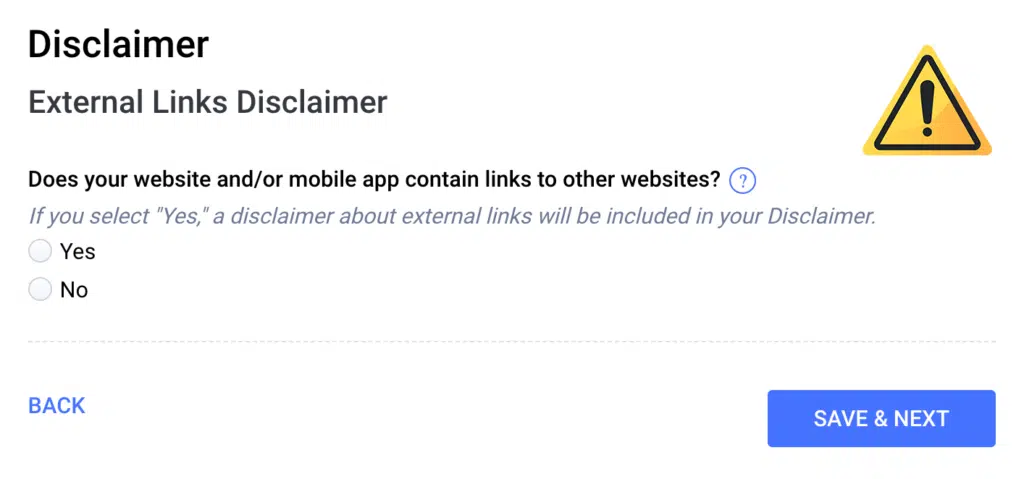
Step 3: Once you’ve filled in everything and you are satisfied with the preview, click “Publish.” You will then be prompted to create an account on Termly so you can save and edit your legal disclaimer further.
What Is a Disclaimer?
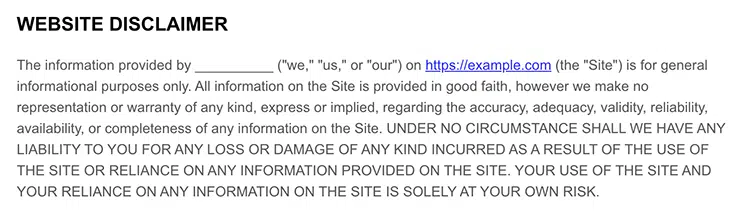
A disclaimer is a legal statement that can help reduce a business’s legal liability. For example, they may protect a business from legal claims arising from users and third-party risk.
Your disclaimer serves as a warning notice when people visit your blog or website. It informs readers that following your advice, purchasing your products, or using your services may harm them and that you are not liable.
What Types of Disclaimers Are There?
Depending on the nature of your business and the information you share on your website, you may need one or more of these types of disclaimer:
What Is An Affiliate Disclaimer?
An affiliate disclaimer lets your website users know you may earn affiliate commissions from products you recommend.
If you have affiliate links in any part of your website, the 2009 Federal Trade Commission (FTC) 2009 Guides Concerning the Use of Endorsements and Testimonials in Advertising mandates that you inform your site visitors.
A good example of this type of disclaimer is the Amazon affiliate disclosure, which is required by the Amazon Associates program, one of the most popular affiliate programs on the internet.
What Is A Testimonial Disclaimer?
A testimonial disclaimer is a statement that informs readers that the experience they’ll have when using your products or services may differ from what they see in your testimonials or reviews.
See our testimonial disclaimer examples if you’re unsure what kinds of testimonials need to be disclosed.
What Are Legal Disclaimers?
If you run a legal website, you may need to include some important legal disclaimers to comply with various professional rules and ethics and protect yourself from liabilities or misconceptions.
- No Attorney–Client Privilege: This disclaimer states that when a client contacts you through your blog, it does not create an attorney–client privilege. In other words, it tells clients that any emails, contact forms, or chats submitted through your site are not confidential.
- Attorney Advertising: You also need to include the phrase “Attorney Advertising” on a prominent page on your legal site. Some jurisdictions have different requirements — to make sure your site complies with the law, you should check your state’s regulations.
- Misleading Information: Your attorney advertising cannot contain false or misleading information that would deceive clients. Advertising must be based in fact, and shouldn’t promise specific results or make claims that would lead a client to have unreasonable expectations concerning a case’s outcome.
- Specializations: Don’t claim or suggest you’re an expert in any areas of the law on your legal site unless you’re aptly certified. Using the correct legal disclaimer language is critical so you don’t mislead your users.
- Identify Attorneys: Most states require you to identify which attorneys are responsible for your site. This implies that you should also include your firm’s name and address.
- Liability for Costs: Are your clients responsible for costs, no matter the outcome of their case? Whether payment depends on a case’s outcome is up to you, but you need to clarify on your website what your policy is.
What Are Medical Advice Disclaimers?
If you run an online business or app that offers medical advice, you need to inform users that the information on the site is only meant to educate and is not intended to replace medical advice from a healthcare provider.
This is known as a medical advice disclaimer.
You may also include that using your site or application does not establish a doctor-patient relationship.
What Are Professional Blog/Services Disclaimers?
If you run a professional blog or have a professional service platform, you need to state that the content on your site is strictly for educational purposes and does not amount to professional advice.
What Is A Product Disclaimer?
A product disclaimer helps you protect your business against any liability that may come from the use of your product.
For example, product disclaimers often state that the seller does not offer any warranty for the products.
You can also use it to protect your business from claims that arise from injuries sustained by misusing your products.
What Is A Copyright Disclaimer?
A copyright disclaimer informs your site users that the site’s content (text, images, and video , etc.) are subject to copyright protection.
In addition, you can state the rules guiding the use of your content.
Or, if you use any copyrighted content on your website without permission, identify it clearly, and include that you’re using it lawfully under the principle of fair use.
What Is A Views Expressed Disclaimer?
A views expressed disclaimer asserts that the opinions expressed in an article or any written material are those of the author and not the opinion of the website.
Publishers usually use this to protect themselves from liability.
Also, persons belonging to an organization use this disclaimer to clarify that anything they say is their individual opinion, not their organization’s official stance.
What Is A Past Performance Disclaimer?
A past performance disclaimer informs users that any past performance they know about does not guarantee future results. So you’re letting them know that what happened previously won’t necessarily happen again.
This disclaimer statement is popular among investment advisers or consultants that offer investment or financial advice to the public.
What Is A Use at Your Own Risk Disclaimer?
If you have a site where you share tips on how people can achieve results in specific areas, you may want to include this disclaimer.
For instance, if you run a website that shares recipes or skincare advice, a user may have an allergic reaction from following your recommendation. This disclaimer may protect you from any claim they may bring against you.
What Are Warranty Disclaimers?
Warranty disclaimers can help you protect your business from liability if your any of your goods or services don’t meet the expectations of your customers or if your products are misused.
What Are Confidentiality Disclaimers?
A confidentiality disclaimer is commonly used in email to inform the recipient that the information in the email is for their eyes only and should not be shared with others.
Confidentiality is an especially important principle in education, law, and healthcare, which are industries that transfer lots of sensitive information via email.
The Health Insurance Portability and Accountability Act (HIPAA) requires persons sending protected health information to US medical patients to include a confidentiality disclaimer. You’ll need a confidentiality disclaimer statement if you do this.
What Are No-responsibility Disclaimers?
A no-responsibility disclaimer, otherwise known as a no-liability disclaimer, is a statement that helps you prevent claims of civil liability by your customers.
Most websites have one somewhere on their website because it helps protect your business if a person misuses your products or services.
Are You Legally Required To Have a Disclaimer?
While some disclaimers are not mandated by law, others are legally required.
For example, the FTC requires you to include an affiliate disclosure if you receive any compensation, whether in cash or in-kind, from a company for reviewing or recommending their product.
An earnings disclaimer is another type of disclaimer that the FTC mandates for websites offering investment advice, financial advice, or money-making opportunities.
If you have a website where you share information on any of the above, especially if you use reviews or testimonials to promote your offerings, the FTC requires you to let users know that results are neither typical nor guaranteed.
You should have these disclaimer on your site and any online platform you use.
In some professions, such as law, professional rules and ethics mandate the use of certain disclaimers.
For instance, in some states, you must be clear that your legal site is used for advertisement.
According to Rule 7.1(f) of the New York Rules of Professional Conduct, lawyers in New York must include the words “Attorney Advertising” on their website’s home page.
Some affiliate programs, such as the Amazon Associates Program, require their affiliate partners to have an affiliate disclosure on their sites. So, having an affiliate disclaimer is both legally mandated and a best business practice.
Does a Disclaimer Legally Protect You?
Yes, a disclaimer legally protects you in some instances.
Having a disclaimer on your website warns users of the risk involved with using your products, services, or content, which will help set your website users’ expectations.
A disclaimer may discourage them from bringing a civil action if they are injured by or dissatisfied with the information or products you offer.
What CAN’T a Disclaimer Do?
It’s important to note that disclaimers do have limits. You can’t use a disclaimer to protect yourself from your own inappropriate behavior.
For example, if you make false claims in your advertising or intentionally share misleading information, a disclaimer won’t save you from the repercussions.
You also can’t use a disclaimer to shield yourself from liability for defaulting on your legal obligation to your website users or customers.
The laws governing the use of disclaimers may not be as clear cut as the use of a privacy policy, which is compulsory in many countries, or the use of terms and conditions, but you can still take certain steps to give your disclaimers a stronger chance of being enforceable.
Do You Need a Disclaimer on Your Website?
Yes, you most likely need a disclaimer on your website.
You may also need one on any other online platform you use in your business, such as your mobile apps or emails.
Having a website disclaimer can help you align with legal expectations, keep users properly informed, protectys your business, and may save your time, money, and business reputation down the line.
Why Should I Have a Disclaimer?
Here are some reasons you should have a disclaimer:
Disclaimers Safeguard Your Rights
Having a disclaimer can help protect your rights.
For example, a copyright disclaimer on your website will notify users that all the materials on your site are subject to copyright laws. It protects your copyright and discourage others from infringing on your intellectual property.
Or, if you have a website where you use other people’s copyrighted material under the law, a fair use disclaimer can help protect your right to do so.
By stating clearly your rights to use copyrighted materials without permission, you’re notifying users and the owners of the materials that you’re aware that the law protects your actions.
This will help prevent you from being barraged with legal actions like cease-and-desist letters and litigation.
Disclaimers Limit Your Liabilities
Every business comes with risk, but a disclaimer can help you significantly reduce your risk exposure.
Specific disclaimers like medical disclaimers and use at your risk disclaimers can protect you from liability claims from persons who may claim to have suffered injuries from following your suggestions.
Imagine a situation where anyone can visit your website, act on the information you share, and sue you if they suffer any harm because of it.
Without these disclaimers, it would be challenging to run an online business successfully without being drowned by liability claims.
Disclaimers Help You Disclaim Third-Party Liability
Disclaimers help ensure you are not responsible for the actions of others.
By informing users that you work with third parties and you don’t make any guarantee as to the effectiveness or accuracy of their content, services, or products, you can ensure you won’t be liable for other people’s failings.
Having a disclaimer on your website can prevent you from being held responsible for people’s comments on your site or social media platforms.
Also, if you allow advertising on your website and social media pages, a disclaimer can shield you from being held responsible for any liability.
Disclaimers Help Protect Your Organization’s Reputation
With disclaimers, you can prevent your actions from affecting the interest of any organization you’re affiliated with.
For example, if you own a blog where you share your opinions on issues, a disclaimer can help you clarify that your views are yours and not your organization’s.
Similarly, if you publish guest posts or allow comments on your website, a disclaimer can help detach your business from other people’s opinions on your website or blog.
This can save your business from any backlash or liability that may come from such opinions.
Disclaimer May Help Shift Legal Responsibility to Employees
Employers are often liable for their employees’ actions because it is assumed that they’re acting on their employer’s directive. However, as a business owner, you can help protect yourself from liability for your employees’ actions with a disclaimer.
For instance, you can include an email disclaimer stating that the views and opinions expressed in the email are those of the author and do not necessarily reflect the company’s views and opinions.
You can further state that employees are not authorized to make defamatory statements and that the company will not be responsible for such statements can save you from trouble.
So, if an employee defames a customer, you can rely on that disclaimer to shift the responsibility to the employee.
Disclaimers Help Build Trust with Site Visitors
Consumers appreciate it when a business is transparent in its dealings with them.
Having website disclaimers helps show website visitors that the company is transparent.
In addition, disclaimers help to set the expectations of your users, which means you’ll be less likely to disappoint them.
What Should Be Included in a Disclaimer?
The content of your disclaimer depends on the nature of your business and the liability you want to protect it from, for exammple:
- Make sure your disclaimer is accurate,
- Discuss liability for tangible goods,
- Discuss liability for services,
- Disclose your copyright notice,
- Remove third-party liabilities,
- Disclosures for multiple content providers,
- Discuss compensation limitations,
- Express trademark details.
Make Sure Your Disclaimer Is Accurate
State that your business does not take responsibility for any inaccuracy in any information shared on your website.
This clause is crucial because the information you believed was correct may actually be (or become) false.
This clause ensures that anyone who relies on the information stated on your website and suffers harm due to it cannot hold you liable for their losses or injuries.
By including this clause, you place the responsibility on your site users to verify any information they see on your site before relying on it.
Discuss Liability for Tangible Goods
If you sell physical products, whether you are the manufacturer or not, warn users that they can’t hold you responsible for any injury they suffer from using your product.
If you are a seller, be sure to include that you’re not responsible for any product warranties or warranty-related claims.
You may also include that the product specifications on your site were provided by the manufacturer. This protects you from any defects or inaccuracies in the product specifications.
It’s common to include the phrase “as is” to let customers know that the product they will receive is exactly as they saw it on your online store. This helps protect you from any misconceptions a customer has about your products.
Discuss Liability for Services
This clause is important if your business provides a service or an opportunity for your clients to use certain equipment, such as a gym.
Your disclaimer should state that using your equipment carries inherent risks, and you won’t be responsible for any injury clients suffer while using your equipment.
Disclose Your Copyright Notice
A copyright notice informs users that materials shared on your website are protected by copyright law. And so, they can’t use your content in a way that infringes on your copyright without your permission.
If you used other people’s copyrighted content without their consent, acknowledge the use and state that the use of the content is under law.
Remove Third-Party Liabilities
Explain that you don’t take responsibility for information contained on third-party websites your website links to.
If you allow other people’s advertisements on your site, clarify that you don’t endorse any advertisement.
You can also include that your site reserves the right to remove any comment you deem offensive, and you’re not liable for any opinion shared.
Disclosures For Multiple Content Providers
If your website publishes articles, guest posts, featured pieces, or opinions, state that the thoughts and opinions expressed are those of the authors.
Specify that you’re not responsible for any such opinion or thought. Having this clause may protect you from a libel suit.
If you also share your opinions on your site, you should state that the information you share is not a fact but your opinion on different issues.
Discuss Compensation Limitations
You can have a clause limiting the amount of money anybody can claim for any injury or loss they sustain from using your site, services, or product.
Make sure you state the specific amount in simple terms.
Express Trademark Details
If you use other people’s registered trademarks on your website, a disclaimer statement disavowing your business of any affiliation with them is proper.
For example, if you sell products from different manufacturers on your site, you may have their logos displayed on your website.
You should state that there is no special relationship between you and them, if none exists.
What Makes a Good Disclaimer?
Having a good disclaimer is vital to help protect your business from liability. Follow these tips to create a good disclaimer.
- Don’t Copy a Disclaimer from Another Website: Your business is distinct from other businesses. So, what you need to include in your website disclaimer may differ from what another business needs. If you copy another website’s disclaimer, you will have a disclaimer that doesn’t cater to your needs.
- Write in Clear Language and Avoid Legalese: Unless you have a business that caters only to lawyers, most of your website users are normal, average human beings to whom legal jargon won’t make much sense. So, in all cases, avoid legalese and write your disclaimers in simple, everyday words that a person of average intelligence can understand.
- Seek Legal Advice from an Attorney: You may hire a lawyer to write or review your website disclaimers or advise you on the disclaimers you need to have on your website. However, you should consult with a lawyer with some level of experience in your industry, not just any lawyer. An attorney with industry experience understands your business and knows what liability you most need to protect yourself from.
- Use a Disclaimer Generator: Disclaimer templates may give you an idea of what you are aiming for, but they are a one-size-fits-all approach, which rarely works. Your business is unique and has particular needs. Therefore, something as important as a disclaimer deserves to be given the appropriate attention. A disclaimer generator may be a better alternative to a disclaimer template.
Where Should You Post Your Disclaimers?
You can put your website disclaimer in a few parts of your website. Often, the type of disclaimer determines the appropriate place to post it.
A common practice with disclaimers is to post them where they are conspicuous. Some of the most common places you can post your website disclaimer include:
- Inside Current Legal Policies: Websites need to have various policies intended to protect both the site owner and the visitors. You can include your disclaimer inside your relevant legal policies. For example, you can include a third-party disclaimer in your terms and conditions and a product disclaimer in your refund policy.
- Informational Menu or Section: You can include disclaimers as part of your menu. For example, you can build a webpage, state your disclaimers on the page, and make it accessible from your menu.
- Website Footer: Many websites display a link to their disclaimer in the website footer alongside other key website pages, such as terms and conditions and privacy policy. Having your disclaimer as part of your footer gives every web user ample opportunity to read your disclaimers.
- Banners and Pop-Ups: You can post your website disclaimers as banners or pop-ups. Displaying your disclaimers in one of these ways gives them more chance of being seen and read. Since a website user often has to click to close a pop-up, when your disclaimers are displayed as pop-ups, it will be harder for your visitors to claim that they didn’t see it.
- End of Content/Articles: Some disclaimers, like an opinions expressed disclaimer, can be added at the end of the article. After they read the article, you can immediately let the user know that the views expressed are not necessarily yours, so they know who to look for if they want to sue.
- Sign-Up Pages: You can display your disclaimers where users will encounter them while signing up to use your website. For instance, you can add a link to your disclaimers on your sign-up page so every user has the opportunity to view them before they go ahead.
- During Checkout: You can post your disclaimers at the checkout point when users are about to purchase a product. Disclaimers like product liability may be especially effective at this point.
- In Any Advertisements: If you run advertisements on your site, the best time to show your third-party disclaimer may be before or after the visitor watches or reads the ad.
What Are Some Good Examples of Website Disclaimers?
Below, I rounded up some good examples of disclaimers for you to consider.
Legal Disclaimer Example From Rich, Intelisano, and Katz
The law firm Rich, Intelisane, and Katz website provides some strong examples of disclaimers that you might find useful to look at.
As shown in the screenshot below, it complies with the New York requirement of including the phrase “attorney advertising” on their home page.
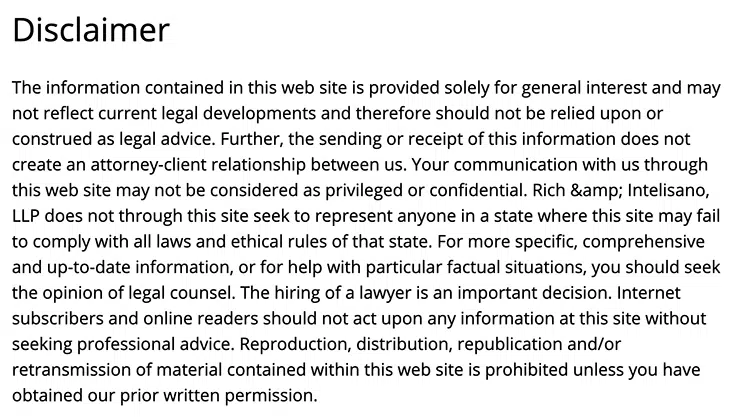
They have this plus their disclaimer in their website footer, which means both the phrase and their disclaimer policy are visible on any page.
Their disclaimer explains to the reader that the information contained does not amount to legal advice and strongly urges the reader not to rely on any information contained on the site without legal advice.
This disclaimer is a great example of covering your bases without being wordy.
Liability Disclaimer Example From BCS
Another good example of a liability discalimer that covers a lot of important details comes from the BCS website, a chartered website for IT professionals.
Take a look at their easy to read but extensive disclaimer page in the screenshot below.
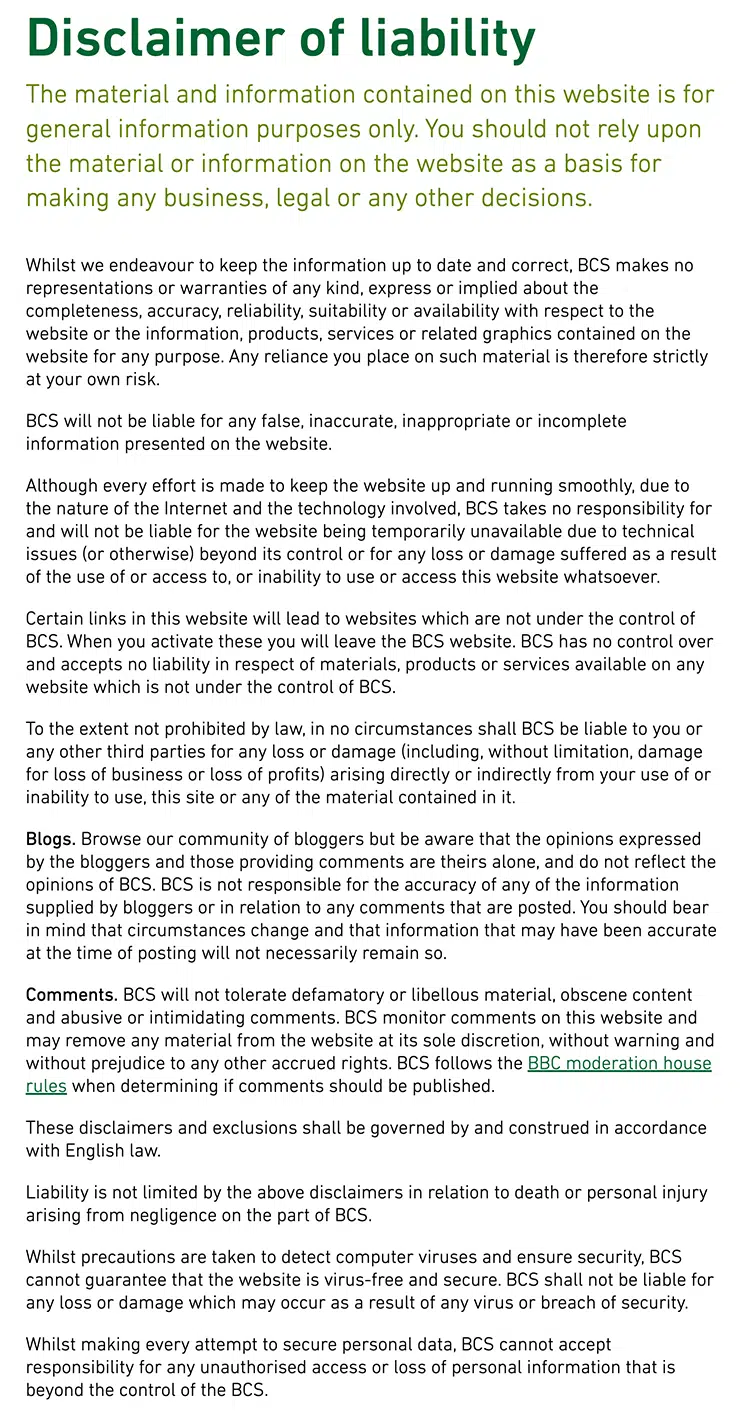
The organization, among other things:
- States that information on their site should not be construed as advice and should not be relied on,
- Disclaims liability for any inaccurate statement on their website,
- Specifies that they won’t bear responsibility if anyone suffers damage because their site is temporarily unavailable,
- States that they link to third-party websites and are not liable for any information contained on those websites.
They do a lot with a little amount of space, which is something you can consider doing with your own disclaimers.
Disclaimer FAQs
Below, you can read through some answers to frequently asked questions we get about disclaimers and disclaimer templates.
How do you write a disclaimer statement?
To write a disclaimer statement, follow these steps:
- First determine what kind disclaimer you want to create,
- Then find examples of other versions of the disclaimer online for inspiration,
- Write your own unique disclaimer language, ensuring you’re accurate and following all applicable legal guidelines,
- Use clear, easy to read language,
- Format the disclaimer so it’s easy to follow by using a proper title and readable font,
- Publish it in the footer of your site, on your legal page, or in other relevant places.
Does my website need a disclaimer?
Yes, your website most likely needs a disclaimer in order to help keep your visitors properly informed, and to protect your site against malicious users or other risks.
Are disclaimers legally required?
While disclaimers are not always legally required, posting them can help you align your site with legal requirements and obligations.
Conclusion & Additional Resources
Disclaimers help businesses minimize their risk exposure and enable site visitors to have the right expectations.
Having the proper disclaimers on your website and online platforms is a must if you want to protect your business.
Our disclaimer template and generator can help your business create disclaimers in no time!
For even more information about disclaimers, check out these additional resources:
- Do you need a disclaimer on a blog?
- Do I need a disclaimer on my website?
- Why is a disclaimer important?
- Can I copy someone else’s disclaimer?
- How do I add a disclaimer to my website?
- Do I need an email disclaimer?
- Does a disclaimer protect you?
- Why do you need a disclaimer?
- How do you write a product disclaimer?

Natasha Piirainen is a privacy writer with a Bachelor’s Degree in English and Philosophy from Wheaton College and over 10 years of professional experience in research-driven content development.
Read all posts by Natasha Piirainen
Reviewed by Masha Komnenic CIPP/E, CIPM, CIPT, FIP
Masha Komnenic is a legal counsel and Termly’s Director of Global Privacy, who received her law degree from Belgrade University. She specializes in implementing, monitoring, and auditing business compliance with privacy regulations (HIPAA, PIPEDA, ePrivacy Directive, GDPR, CCPA, POPIA, LGPD).
Read all posts reviewed by Masha Komnenic CIPP/E, CIPM, CIPT, FIP
Generate a FREE Legal Disclaimer